
Space Bunny Alpha vs Other AI Agents
9 min read
Installing Space Bunny Alpha is the subject of a separate article. The question here is different: where does it sit in the field, what does it do better than the alternatives, and what does it not do at all?
The honest answer to that starts with how new the model is. At the time of writing, Space Bunny Alpha had been on OpenRouter for four days. So let me open with a warning: the comparison below is built on published technical specifications, not on an independent benchmark. There are deliberately no score tables, no speed measurements and no "X beat Y on test Z" claims. If you have not run those measurements, nobody can run them reliably for you, and an invented ranking would make the whole article worthless.
What we do have is this: OpenRouter publishes each model's context window, price, accepted input modalities, supported API parameters and reasoning tiers. Those numbers are not open to debate, and they have no debateable side. Building the comparison on top of them is both more honest and more durable.
The frame for this comparison
I am looking at five questions:
- Price. What does a month actually cost?
- Context window. How many tokens fit?
- Input modalities. Text, image, video, audio, files?
- Agent capabilities. Tool calling, structured output, reasoning control?
- Transparency. Weights, training data, knowledge cutoff, content filtering?
The fifth question is usually skipped in model comparisons, but here it is the most distinguishing one. When you do not know who built a model, you also have nothing left to hold on to when you want to know why it produced the code it produced.
All data was taken from OpenRouter's model API on September 27, 2026. Prices are list prices and they can change.
The basics
| Model | Context | Max output | Input modalities | Price (in / out, per million tokens) |
|---|---|---|---|---|
stealth/space-bunny-alpha |
1,000,000 | 524,288 | text, image, video | $0 / $0 |
anthropic/claude-opus-5.5 |
1,000,000 | 128,000 | text, image, files | $4 / $20 |
openai/gpt-6-luna |
1,050,000 | 128,000 | text, image, files | $0.10 / $0.50 |
google/gemini-3.8-flash |
1,048,576 | 65,536 | text, image, video, files, audio | $0.75 / $3.75 |
qwen/qwen3.8-27b:free |
262,144 | 235,929 | text, image, video | $0 / $0 |
thinkingmachines/inkling:free |
1,048,576 | 262,144 | text, image, audio | $0 / $0 |
nvidia/nemotron-3-ultra-550b-a55b:free |
1,000,000 | 65,536 | text | $0 / $0 |
The first thing your eye catches is the price column. Two models sit at zero, and between the rest there is a two-hundred-fold spread. In the context column almost nobody differs: six of the seven models are around a million tokens. Which means a 1M context window is no longer a distinguishing feature, just a desktop expectation.
Cost comparison
Reading the raw price ratio is misleading. Let us run a real scenario instead.
Assume: 30 requests a month, each with 200,000 input tokens and 50,000 output tokens. That roughly corresponds to one turn of an agent session on a multi-file codebase. Thirty turns means a few hours of active work per month.
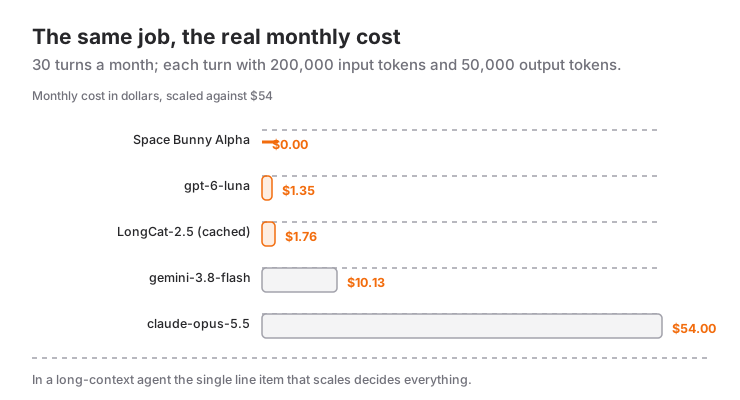
| Model | Per request | 30 requests a month |
|---|---|---|
stealth/space-bunny-alpha |
$0.00 | $0.00 |
openai/gpt-6-luna |
$0.045 | $1.35 |
google/gemini-3.8-flash |
$0.3375 | $10.13 |
anthropic/claude-opus-5.5 |
$1.80 | $54.00 |
The calculation is input_tokens × input_price + output_tokens × output_price, with the raw token counts.
The biggest surprise here is not Space Bunny Alpha but openai/gpt-6-luna. At $0.10 and $0.50, the per-million-token cost is extremely low by the standards of closed models. Being able to spend $1.35 a month on a 1M-context model that calls tools and reads images quietly disproves the assumption that "non-free models are expensive."
Space Bunny Alpha's advantage is sharper than that: the row is zero, exactly zero. But for the same reason it is not a sustainable line item. When the model is retired, the whole cost gets re-determined. The fixed-price plans described in the opencode article are exactly the way to remove that uncertainty.
Input modalities
The short answer: video input exists in none of the closed models, and it is common among free open models.
Space Bunny Alpha accepts text + image + video. Claude Opus 5.5 and GPT-6 Luna read images but not video. Gemini 3.8 Flash accepts all five modalities, but at $0.75 / $3.75 with a 65,536 token output ceiling.
On the open side qwen/qwen3.8-27b:free offers the same trio with a 262,144 token context. So two free models do take video input, but one cannot offer the 1M context. Space Bunny Alpha's position in this row is the single point where the limits overlap: a million tokens, video input and a zero price at the same time.
There is a gap on audio. Inkling and Gemini take audio; Space Bunny Alpha does not. If you are building a voice product, that row eliminates it.
Agent capabilities
For a model to be useful as an agent it has to do four things: read the tool schema, pick the right tool, call it with valid arguments, and use the result on the next turn. Which API parameters are supported decides that directly.
| Capability | Space Bunny Alpha | Claude Opus 5.5 | GPT-6 Luna | Gemini 3.8 Flash |
|---|---|---|---|---|
tools |
yes | yes | yes | yes |
tool_choice |
auto only |
full | full | full |
response_format |
yes | yes | yes | yes |
| Reasoning switchable off | no | no | yes | no |
| Default tier | max |
high |
medium |
medium |
| Available tiers | 5 | 5 | 6 (incl. none) |
3 |
seed |
no | no | yes | yes |
stop |
no | yes | no | yes |
temperature / top_p |
yes / yes | yes / no | no / no | yes / yes |
Two rows here have a practical consequence.
tool_choice only accepts auto. In other words you cannot tell the model "call a tool, do not choose" or "call this specific tool". For most agent loops that is not a problem, because tool selection is left to the model anyway. But if your flow needs "you must call this tool", you either have to push it hard in the prompt text or this model is the wrong fit for that flow.
reasoning_effort: max is the default. The same tier is high for Claude Opus 5.5 and medium for GPT-6 Luna. None of the three can be switched off, but a two-tier difference shows up in latency. Writing low for simple work is a meaningful saving.
There is also a visible gap in consistency: there is no seed, so two calls with the same prompt give no guarantee of the same answer. Even writing temperature: 0 does not fully restore that. If you need reproducible output in tests, this is a real limitation.
Space Bunny Alpha and JEV: not competitors
A question that comes up often in the JEV article on this site: JEV is also cheap, it is also a model, so why should I pick Space Bunny Alpha?
The answer is that the two work at different layers. JEV does not generate free text; it takes a state and typed questions and returns a decision. You use it to tell whether an email is an invoice, a sponsorship pitch or spam. Space Bunny Alpha is a generative language model: it writes code, explains things, reads images and calls tools.
So the two are not alternatives, they are complements. If you are building a strict classification layer, use JEV; if you are building an agent that generates text around that decision, use Space Bunny Alpha.
The same logic is behind the split in the harness article: a model is a function that takes text and returns text. An agent's behavior is determined by the model and by the loop you build around it.
Who should pick what
Rather than collapsing this into one table, start from the line closest to your problem:
If the cost genuinely has to be zero and you are comfortable experimenting: stealth/space-bunny-alpha. 1M context, video input, tool calling, a zero bill. You have to be able to accept the risk.
If you can pay and quality comes first: the closed flagship models. gpt-6-luna deserves particular attention, because it is the cheapest closed model in this table and has the largest context of them all.
If you need a large codebase read in a single session: gpt-6-luna or gemini-3.8-flash. Both have 1M context and their monthly cost stays under twelve dollars.
If you need a model you can run yourself: the free open models other than Space Bunny Alpha. Their weights are on Hugging Face and the hugging_face_id field is populated. You can run them on your own server, on your own data. That is not possible for Space Bunny Alpha.
If you are building a voice product: Space Bunny Alpha drops out. There is no audio input.
If transparency matters most: pick an open-weights model. For nvidia/nemotron-3-ultra-550b-a55b:free or qwen3.8-27b:free you can inspect the training data, the license and the weights. You also have to compensate for the is_moderated: false value with your own input checks, using the same validation logic as the safety article.
How long this table stays valid
Honestly, the shortest-lived part of this comparison is the price column. There are three uncertainties and all three sit outside the model:
Free may be a limited-time thing. The model lists at $0 today. Other models listed at $0 yesterday, and three months later they are gone from the list. At the time of writing exactly 21 models on OpenRouter were free for both input and output; that is an observation, not a promise.
The name and version can change. The provider shipped a version carrying an alpha tag. That name is a sign of instability: the same id may point at a different model tomorrow. If you use it in production, pin the model id and watch for behavior changes.
The provider is a single point. Space Bunny Alpha currently has one endpoint, with uptime around 99.9% over the last 24 hours. A single endpoint is both good and bad: routing is simple, but if it drops there is no other endpoint to fall back to. Multi-endpoint models spread that load.
There is also no published knowledge cutoff. That means you do not know up to which date the model saw the world, which matters when you teach citing sources.
Sources
- OpenRouter model API (context window, price, input modalities, supported parameters, reasoning tiers,
hugging_face_id) - OpenRouter endpoint details: Space Bunny Alpha (
tool_choicesupport, uptime,is_moderated, implicit caching status) - OpenRouter model page: Space Bunny Alpha (summary, provider)
Related Posts
Space Bunny Alpha: 1M Context and Multimodal Input
What a one-million-token context window really holds, how image and video input share that budget, and how to measure and manage your token budget.
How to Install Space Bunny Alpha: Step by Step
Setting up Space Bunny Alpha via OpenRouter: the API key, the first request, Python and TypeScript samples, image input, open-source agents.
Building an AI Agent With Space Bunny Alpha
From tool schema to loop: writing a working coding agent on Space Bunny Alpha, feeding tool errors back to the model and locking the output to JSON.