What Is Claude Fable 5.2? Price, Mythos, Access
8 min read

Claude Fable 5.2 is an AI model Anthropic released on November 9, 2026, built for demanding reasoning and long-horizon agentic work. Its API model ID is claude-fable-5-2; it has a 1 million token context window and a 128K token output limit, and it costs $8 per million input tokens and $40 per million output tokens. According to Anthropic it is both cheaper than Fable 5.1 and more capable on most benchmarks.
This post is a news roundup and compilation; I have not tested the model. The numbers come from Anthropic's announcement, product page and developer documentation; they are not an independent reproduction. The details are in separate posts: pricing and cost, who can use it and how to access it, and the comparison with rivals.
The news at a glance
Anthropic's documentation describes the model as "For demanding reasoning and long-horizon agentic work." The key facts:
| Feature | Value |
|---|---|
| Model name | Claude Fable 5.2 |
| API model ID | claude-fable-5-2 |
| Release date | November 9, 2026 |
| Status | Active (latest); retirement no earlier than November 9, 2027 |
| Context window | 1 million tokens |
| Max output | 128K tokens (synchronous Messages API) |
| Input / output | Text and image input, text output |
| Knowledge cutoff | June 2026 |
| Latency | Moderate |
| Default effort (API) | high |
| Price | $8 input / $40 output (per million tokens) |
| Sibling model | Claude Mythos 5.2 (claude-mythos-5-2) |
The short history of the Fable family, per Anthropic's product page: Fable 5 shipped on June 9, 2026, access closed on June 12 and reopened on July 1; the biology safeguards were updated on August 6; Fable 5.1 arrived on September 1 and Fable 5.2 on November 9. Anthropic says 5.2 produces output "up to 30%" faster than Fable 5.1 and Mythos 5.1.
What Fable 5.2 does well
Here is what Anthropic highlights (all of it the company's own reporting, with no outside verification):
- Agentic coding. 69.9% on FrontierSWE v2 (Opus 5.5: 62.3%) and 49.1% on FrontierCode 2.0 at Xhigh effort.
- Long, multi-agent work. Anthropic describes an engineer starting from an empty folder and having the model coordinate more than 1,000 sub-agents for eight days to produce a working operating system, and says the model formalized Fermat's Last Theorem in Lean in 30 hours.
- Scientific and physical work. Two open problems in theoretical physics, three working electronic devices from scratch, progress on robotics evaluations.
- Computer use. 89.3% on the OSWorld 2.1 offline subset.
How to read each of these claims is covered in the what-can-it-do post, and the full table is in the comparison post. In short: Fable 5.2 leads on most rows of the table, but not everywhere; Gemini 4 Carbon is ahead on AutomationBench (53.9% vs 51.4%).
Are Fable and Mythos the same model?
Yes. In Anthropic's words, Claude Fable and Claude Mythos are the same underlying model. Claude Mythos 5.2 is the version of Fable 5.2 without certain cybersecurity and biology safeguards; Fable's safeguards are what make it possible to offer the model to everyone. Price and features are the same.
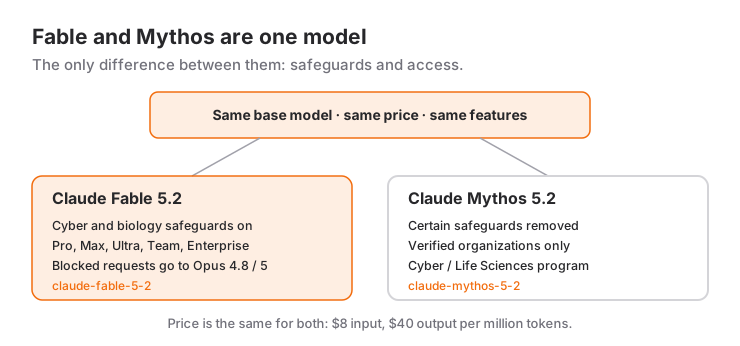
Mythos is closed to general access. It goes to verified organizations through the Cyber Verification Program and the Life Sciences Verification Program. Anthropic calls Mythos "our most capable model for cybersecurity engineering," while Fable's safeguards block most cybersecurity tasks. The Mythos numbers (CVE Rediscovery 89.6%, Terminal-Bench-Science 75.3%) are Anthropic's own measurements.
Safety and safeguards
On Fable 5.2, classifiers block high-risk cyber activity (penetration testing, exploit generation, binary-based vulnerability work) and most research biology tasks. A blocked request can be routed to Claude Opus 4.8 for cyber and to Claude Opus 5 for biology; API customers need to set up the new Fallback API for that.
Other points from Anthropic:
- The safeguards are as robust as in 5.1 with fewer unnecessary blocks: in early testing in claude.ai, Claude Code and Cowork, about 55% fewer blocks than Fable 5.1 (about 60% fewer for cyber, about 40% fewer for biology).
- Accelerator kernel optimization and LLM architecture improvement capabilities were kept close to Opus 5.5 level during training. Agentic coding, hardware development and ML research were not affected.
- Protection against distillation was strengthened: Anthropic says the data distillers collect fell by 90-99%.
- The risk of unsafe behavior in high-stakes situations is "low." In the automated behavioral audit, Mythos 5.2 scores 2.67 for misalignment (Opus 5.5: 2.79; lower is better).
- Both Fable 5.2 and Mythos 5.2 voice suspicion that they are being evaluated more often than earlier models.
The UK AI Security Institute, Frontier Design and METR ran outside tests; however, a footnote from Anthropic says these organizations did not review the post or the system card and may not agree with the claims. I have not read the system card either.
Price and access in brief
The price is $8 per million input tokens and $40 per million output tokens; cache reads cost $0.20. The Batch API gives a 50% discount, and fast mode costs twice the standard price. All line items and worked examples are in the pricing and cost post.
On access, Anthropic's product page says Fable 5.2 is available to Pro, Max, Ultra, Team and Enterprise users; the free plan is not mentioned. The model is available in the Claude apps, Claude Code, Cowork and the API (Claude Platform, Amazon Web Services, Google Cloud, Microsoft Foundry). Step-by-step routes are in the access post.
One detail matters for business users: Fable models require 30 days of data retention by default for safety monitoring. Zero data retention is possible only if Anthropic explicitly authorizes it.
How it differs from Fable 5.1
These numbers come from Anthropic's own table and pages:
| Area | Fable 5.1 | Fable 5.2 |
|---|---|---|
| Price (per million tokens, input / output) | $10 / $50 | $8 / $40 |
| FrontierSWE v2 | 56.3% | 69.9% |
| RoboDojo Sim (Anthropic internal run) | 27.6% | 64.9% |
| Unnecessary blocks | Baseline | About 55% fewer |
| Output speed | Baseline | "Up to 30%" faster |
The price drop is 20% on both line items. For developers, the real work beyond changing the model ID is checking four breaking changes: the prefix check, thinking blocks, the old computer use tool and advisor pairing. The details are in the migration post.
If you are looking for a cheaper tier, there is the Claude Sonnet 5.5 post; Sonnet 5.5 is not part of Anthropic's comparison table here.
Frequently Asked Questions
What is Claude Fable 5.2?
An AI model Anthropic released on November 9, 2026. The documentation describes it as built for demanding reasoning and long-horizon agentic work; its API ID is claude-fable-5-2 and its context window is 1 million tokens.
How much does Claude Fable 5.2 cost?
$8 per million input tokens and $40 per million output tokens. That is 20% below Fable 5.1's $10 / $50. The Batch API cuts it by 50% to $4 / $20, and fast mode costs $16 / $80.
What is the difference between Fable 5.2 and Mythos 5.2?
Anthropic says they are the same underlying model. Mythos 5.2 is the version of Fable 5.2 without some cybersecurity and biology safeguards, and it is open only to verified organizations. Fable's safeguards block most cybersecurity tasks.
Who can use Claude Fable 5.2?
According to Anthropic's product page, Pro, Max, Ultra, Team and Enterprise users, plus developers through the API. The product page does not mention the free plan.
How much better is Fable 5.2 than Fable 5.1?
In Anthropic's table it rises from 56.3% to 69.9% on FrontierSWE v2 and from 27.6% to 64.9% on RoboDojo Sim. Anthropic also reports about 55% fewer unnecessary blocks and output "up to 30%" faster. These are the company's own measurements.
Is Fable 5.2 better than Opus 5.5?
In Anthropic's table it leads on most benchmarks, but on the unlabeled Elo row under AA-Briefcase Opus 5.5 appears ahead. The full comparison is in the comparison post. I have not read an independent measurement.
What is Fable 5.2's knowledge cutoff?
The documentation gives both the reliable knowledge cutoff and the training data cutoff as June 2026.
Sources
- Anthropic, Claude Fable 5.2 and Claude Mythos 5.2 (November 9, 2026; editing note added November 11): announcement, benchmark table, safety and Mythos statements, launch promotion.
- Anthropic, Claude Fable product page: model timeline, plans, price drop.
- Anthropic, Models overview: Claude Fable 5.2: key facts, model IDs, pricing table, effort levels, model comparison.
- Anthropic, What's new in Claude Fable 5.2: breaking changes and migration notes.
Related Posts
What Can Claude Fable 5.2 Do? 1,000 Agents, Fermat
According to Anthropic, Claude Fable 5.2 built an OS with 1,000 agents, formalized Fermat's Last Theorem in 30 hours, and solved two open physics problems.
Migrating Claude Fable 5.1 to 5.2: API Changes
Swapping claude-fable-5-1 for claude-fable-5-2 is not enough: the prefix check, thinking blocks, computer_toolset_20260801 and advisor pairing are breaking.
How to Access Claude Fable 5.2: Who Can Use It?
Claude Fable 5.2 is available on Pro, Max, Ultra, Team and Enterprise plans, in Claude Code, and through the claude-fable-5-2 API ID on major clouds.