Migrating Claude Fable 5.1 to 5.2: API Changes
8 min read
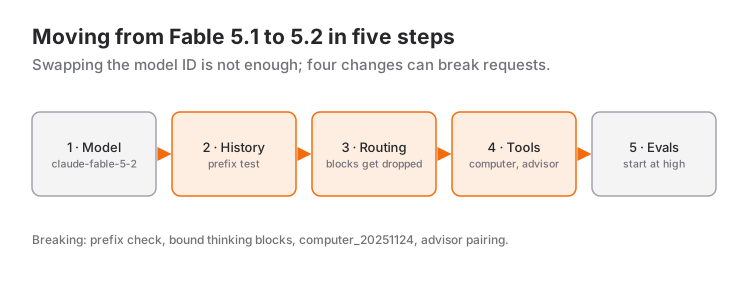
To migrate from Claude Fable 5.1 to 5.2 you change the model ID from claude-fable-5-1 to claude-fable-5-2, but Anthropic's documentation lists four breaking changes: the prefix check now applies to every account, thinking blocks are bound to the model that produced them, the computer_20251124 tool returns a 400 error, and the advisor tool pairs only with Fable 5.2 or Mythos 5.2. The model was released on November 9, 2026, under the ID claude-fable-5-2.
This post is a news roundup and compilation; I have not tested the model or the migration. Everything below is compiled from Anthropic's "What's new in Claude Fable 5.2" page; I did not run it in my own code. The code snippets are raw request bodies using only documented fields; I did not write SDK calls. For the model itself, see What Is Claude Fable 5.2; for access routes, see how to access Claude Fable 5.2.
Short answer
Change the model ID first (--model claude-fable-5-2 in the CLI). Then check whether you edit conversation history, your model router, your computer-use tool and your advisor tool. If you use Claude Code, claude.ai, Claude Managed Agents or the Claude Agent SDK, you do not need to change anything for the prefix check.
Four breaking changes
| Change | What happens | Fix |
|---|---|---|
| The prefix check applies to every account | Sending back an invalid thinking block with prefix_mismatch_behavior unset returns a 400: "The block is bound to a different conversation" |
Do not change system, tools or earlier messages, or use drop_block |
| Thinking blocks are bound to the producing model | Blocks from another model are silently dropped; the request succeeds and dropped blocks are not billed | Do not switch models mid-conversation; if you do, the reasoning of those turns is lost |
computer_20251124 is rejected |
400 invalid_request_error on every platform except Amazon Bedrock |
Use computer_toolset_20260801 |
| Advisor pairing (beta) | A Fable 5.2 / Mythos 5.2 executor rejects any advisor other than those two: 400 invalid_request_error |
Set the advisor model to claude-fable-5-2 or claude-mythos-5-2 |
Step-by-step migration
This is Anthropic's order. Before everything else, change the model ID:
{
  "model": "claude-fable-5-2"
}- Check whether you edit history. If you trim, summarize or rewrite conversation history, run your prefix check test. To avoid code changes,
systemandtoolsmust stay the same throughout the conversation, you should only append tomessages, and every assistant turn should be sent back as it was returned. - Check router and fallback model switches. Every model except Mythos 5.2 drops Fable 5.2's thinking blocks.
- Move computer use. Change the type in the tool definition from
computer_20251124tocomputer_toolset_20260801:
{
  "tools": [
    { "type": "computer_toolset_20260801" }
  ]
}
For the tool's parameters, see Anthropic's computer-use documentation; I am only relaying that the type name changed. Only on Amazon Bedrock InvokeModel can you still send computer-use-2025-11-24 in the anthropic_beta array.
- Change the advisor model in the advisor tool. The advisor's
modelmust beclaude-fable-5-2orclaude-mythos-5-2. Because changing the advisormodeleditstools, do it in new conversations. With Fable 5.2, the advisor's advice comes back encrypted. - Re-run your evals and start the effort sweep at
high. Anthropic's documentation says: "Start there, because most of the gain in capability is already present at high."
The prefix check and thinking blocks
A quote from the documentation: "On Claude Fable 5.2 and Claude Mythos 5.2, a request that sends back an invalid thinking block and leaves prefix_mismatch_behavior unset gets a 400 error, whatever the account's age." On Fable 5.1 the same error applied only to accounts created on or after August 31, 2026; on 5.2 account age no longer matters.
If you would rather soften the error than change your code, send the thinking-binding-controls-2026-08-01 beta header and set thinking.block_binding.prefix_mismatch_behavior to "drop_block":
{
  "model": "claude-fable-5-2",
  "thinking": {
    "type": "adaptive",
    "block_binding": {
      "prefix_mismatch_behavior": "drop_block"
    }
  }
}
Request header: anthropic-beta: thinking-binding-controls-2026-08-01. The response lists the dropped blocks in a top-level input_transformations array. The documentation includes a warning: dropping blocks can increase output tokens.
Thinking blocks are bound to the model that produced them. Fable 5.2 and Mythos 5.2 read each other's blocks; they also read blocks from Opus 5.5, Sonnet 5.5, Haiku 5.5, Fable 5.1, Mythos 5.1, Opus 5, Fable 5, Mythos 5 and older Opus, Sonnet and Haiku models (on the Claude API and Google-managed Google Cloud). If you switch from Fable 5.2 to another model, the reasoning of those turns is lost. Blocks from another account are dropped too (reason: "organization_binding_mismatch").
Behavior differences
No code change is needed for these, but they can affect your prompts and effort settings:
- At
mediumand above, "answer directly, do not think" instructions do not stop thinking. Athighand above the model thinks before almost every response; use low effort for easy turns. - On long multi-step tasks the model can finish early: it lists what is left, offers to continue, or stops at an ordinary obstacle. This happens more often at
lowandmediumeffort. - The wording about code ownership matters: without it, the model tends to add to the existing structure and report nearby problems instead of fixing them.
- In long chains of tool calls it writes little text; it may make the first tool call without saying what it will do.
- It delegates to subagents easily when prompts invite it, and subagents can be a large share of session cost.
- It follows style rules closely: a strict sentence-length limit can make the tone choppy.
- Adaptive thinking is always on and cannot be turned off. Do not send
temperature,top_portop_k.
New features (beta)
- Compaction on demand: header
compact-2026-09-04. - Mid-conversation tool changes: through a
role: "system"message; headersinline-tools-2026-09-15andmid-conversation-tool-changes-2026-07-01. - Server-side fallbacks:
fallbacks: "default". For Fable 5.2 the allowed targets are Claude Opus 4.8 and Claude Opus 5. Categories without a recommended fallback, such asreasoning_extraction, stay refusals. - Refusal response: a refused request returns HTTP 200,
stop_reason: "refusal"andstop_details. Refusal billing depends on the category, and refusals count toward rate limits.
The safeguards route blocked requests to Opus 4.8 for cyber and to Opus 5 for biology; API customers need to set up the new Fallback API.
Which model are you coming from
| Coming from | What is breaking |
|---|---|
| Fable 5.1 | The four changes above |
| Fable 5 / Mythos 5 | Only the forced tool use rule |
| Opus 5 and earlier Opus | Both the thinking and tool_choice rules |
| Opus 5.5 | You see neither |
The thinking rule: thinking: {"type":"enabled"} with budget_tokens, or thinking: {"type":"disabled"}, returns a 400. The migration path is to omit thinking entirely or send {"type":"adaptive"}.
Forced tool use is removed: if tool_choice is {"type":"any"} or {"type":"tool","name":"..."}, you get a 400 invalid_request_error. Use auto with strict: true instead (the tool name is made up for the example):
{
  "tool_choice": { "type": "auto" },
  "tools": [
    {
      "name": "example_tool",
      "description": "Example tool",
      "strict": true,
      "input_schema": { "type": "object", "properties": {} }
    }
  ]
}
The alternative is JSON outputs. Organizations that use customer-managed encryption keys (CMEK) do not get structured outputs; do not use strict, and validate the output in your own code.
Frequently Asked Questions
Is changing the model ID enough to move from Fable 5.1 to 5.2?
No. Setting the ID to claude-fable-5-2 is the first step, but you also need to check the prefix check, thinking blocks, the computer-use tool and advisor pairing. If you do not edit history and do not use those tools, you will often have no problems.
What does "The block is bound to a different conversation" mean?
You sent back an invalid thinking block and prefix_mismatch_behavior is not set. The fix: send system, tools and messages unchanged, or choose drop_block with the thinking-binding-controls-2026-08-01 header.
Does the old computer_20251124 tool still work?
No. It returns a 400 invalid_request_error on every platform except Bedrock. Use computer_toolset_20260801; only on Bedrock InvokeModel can the old beta value be sent in the anthropic_beta array.
Can I use temperature and thinking budgets with Fable 5.2?
Do not send temperature, top_p or top_k. For thinking, enabled with budget_tokens and disabled return a 400; omit the field or use adaptive.
Can I force a tool with tool_choice?
No. any and forcing a specific tool return a 400. Use auto with strict: true, or JSON outputs.
Which models does the advisor tool work with?
A Fable 5.2 or Mythos 5.2 executor accepts only Fable 5.2 and Mythos 5.2 as the advisor. Others, including Fable 5.1 and Mythos 5.1, return a 400.
Do I need to do anything if I use Claude Code?
For the prefix check, nothing changes in Claude Code, claude.ai, Claude Managed Agents or the Claude Agent SDK. If you have your own API code, run the checks above.
Sources
- Anthropic, What's new in Claude Fable 5.2: breaking changes, migration steps, behavior differences, beta features, thinking blocks and the prefix check.
- Anthropic, Models overview: Claude Fable 5.2: model ID, effort levels, adaptive thinking.
- Anthropic, Claude Fable 5.2 and Claude Mythos 5.2 (November 9, 2026; edit note added November 11): safeguards and routing, Fallback API.
- Anthropic, Claude Fable product page: model timeline, release dates.
Related Posts
What Is Claude Fable 5.2? Price, Mythos, Access
Anthropic released Claude Fable 5.2 on Nov 9, 2026: 1M context, $8 input and $40 output per million tokens, 20% cheaper than Fable 5.1.
What Can Claude Fable 5.2 Do? 1,000 Agents, Fermat
According to Anthropic, Claude Fable 5.2 built an OS with 1,000 agents, formalized Fermat's Last Theorem in 30 hours, and solved two open physics problems.
How to Access Claude Fable 5.2: Who Can Use It?
Claude Fable 5.2 is available on Pro, Max, Ultra, Team and Enterprise plans, in Claude Code, and through the claude-fable-5-2 API ID on major clouds.