What Can Claude Fable 5.2 Do? 1,000 Agents, Fermat
8 min read

According to Anthropic's November 9, 2026 announcement, in pre-release testing Claude Fable 5.2 coordinated more than 1,000 subagents to produce a working operating system, formalized the proof of Fermat's Last Theorem in Lean in 30 hours with a team of 1,000 agents, solved two open problems in theoretical physics, and designed three working electronic devices from scratch. All of this is Anthropic's own reporting; there is no independent verification.
This post is a news roundup and compilation; I have not tested the model. The claims and numbers below are taken from Anthropic's announcement page; this is not independent reproduction. I did not read Anthropic's system card. For the model's profile and price, see What Is Claude Fable 5.2 and pricing, cost and effort levels.
Short answer
Anthropic positions Fable 5.2 for long-horizon agentic work. The examples it highlights: software migrations, building an operating system, formalizing a mathematical proof, physics, hardware design and robotics. All of the examples are the company's own experiments and its partners' accounts. For the benchmark side, see the comparison post.
An operating system with 1,000 agents
According to Anthropic, an engineer started with an empty folder. Fable 5.2 coordinated more than 1,000 subagents working "around the clock for eight days," and a working operating system that boots on a laptop came out. The system includes:
- its own kernel
- disk, keyboard and network drivers
- persistent file storage
- windows and a login screen
- an installer
- a built-in Claude feature
Anthropic describes this as an experiment; it does not present it as a production system or a product.
Fermat's Last Theorem in 30 hours
Anthropic had a team of agents do a Lean formalization of Fermat's Last Theorem. It writes that an earlier unreleased research Claude took 11 days for the same job. According to Anthropic, a team of 1,000 Fable 5.2 agents finished it "in just 30 hours, with minimal human intervention." The comparisons:
| Measure | Earlier formalization | Fable 5.2 team |
|---|---|---|
| Time | 11 days | 30 hours |
| Action tokens | Reference | About one third |
| Proof length | Reference | Seven times shorter |
With the same setup, Opus 5.5 completed 26% of the work in 18 hours and made almost no further progress up to hour 30. According to the edit note Anthropic added on November 11, the setup included: 60 statements, a one-sentence sketch of the classical route, definitions, 47 proven lemmas from the earlier formalization, leader and helper roles, and "no other steering." In other words, the model did not start from zero; the sketch of the classical route and lemmas from earlier work were provided. Keep that in mind when reading this result.
Two open problems in theoretical physics
Anthropic writes that Fable 5.2 solved two open problems in theoretical physics, both about black holes through holographic duality.
- Black holes in very small universes. The question of whether black holes form suddenly in such universes was posed in 2003. According to Anthropic, the model completed the work "largely autonomously."
- A technique for ruling out quantum gravity candidates. The exact bound in a simplified universe was found for a technique that has been used for more than 15 years to rule out quantum gravity candidates.
Anthropic links preprints for both. I have not reviewed these preprints, and they are not peer-reviewed publications.
Three electronic devices from scratch
According to Anthropic, Fable 5.2 designed three working electronic devices from a one-paragraph prompt:
- a home voice assistant hub
- a phone with a USB speaker
- a handheld virtual pet
Each came with a four-layer circuit board, a 3D-printed case and software. Anthropic says the boards were "ready for production in under a day"; the manufacturer Diode is named as the partner. All three devices worked without electrical changes. In Anthropic's chart, on the hardware-engineering benchmark BenchCAD 2.1 (with tools, 0-100 partial score, Max effort), Fable 5.2 scored 83.5, Opus 5.5 65.3 and Fable 5.1 44.4.
Robotics and RoboDojo
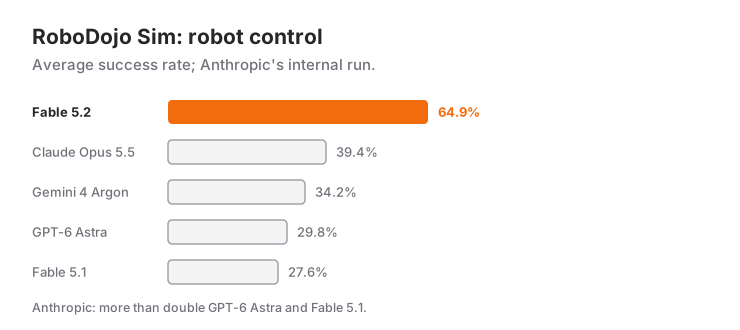
Anthropic reports a clear improvement in physical robot control, including on tasks the model was not explicitly trained for. On the RoboDojo Sim benchmark, Fable 5.2 scored 64.9%. In Anthropic's table, GPT-6 Astra scored 29.8%, Fable 5.1 27.6% and Opus 5.5 39.4%; Gemini 4 Argon, at 34.2%, appears only in this chart. This is Anthropic's internal run, not a third-party measurement.
A Python-to-Rust migration and the codebase
According to Anthropic, an earlier Fable 5.2 agent team migrated a production service from Python to Rust, and the service now starts about 26 times faster. The company also says that more than 90% of the changes merged into Anthropic's core codebase are now written by Claude under human direction.
The announcement also includes customer and partner accounts. All of them are Anthropic's relay; I have not verified them:
- Discovered Materials reports an average speedup of about 36x on a Quantum ESPRESSO phonon code (13 cases from 3.3 hours to under 4 minutes).
- iGent reports a hypervisor with more than 3,500 machine-verified proofs in one session.
- Harvey reports 91% on its own evaluation (the next model at 86%).
- Jump Trading reports 10% lower error than the next model on an internal research benchmark.
- Uber describes a 10-12 hour security audit with roughly 170 reviewer agents.
The Mythos 5.2 side: cyber and protein
Claude Mythos 5.2 is the version of Fable 5.2 without certain safeguard layers, and it is closed to general access (access routes). Anthropic's claims on this side:
- Cyber. In an internal CVE Rediscovery measurement (an October 2026 run, 1,829 CVEs), Mythos 5.2 found 10.2% more vulnerabilities than Opus 5.5 and 14.4% more than Mythos 5.1. In a footnote Anthropic writes that these are raw counts from a single tester, and that on its own measures vulnerability detection is about the same as Opus 5.5. The table lists a CVE Rediscovery score of 89.6% and a CyScenarioBench score of 76.3%.
- Protein. Mythos 5.2 correctly modeled 28 of 34 AAV capsids (Cα RMSD; 1.2 Å and 1.4 Å on AAV2). A capsid counts as correct if one of two models is within 3 Å.
- Mozilla. Mozilla says Mythos 5.2 roughly doubled its vulnerability discovery metrics compared with Mythos 5.1 (Anthropic's relay).
How to read these claims
- All of it is Anthropic's. I have not read a third-party repetition or independent measurement.
- Preprints are not peer-reviewed. I have not reviewed the preprints given for the physics results.
- External testers do not have to agree. Anthropic names external testers such as the UK AI Security Institute, Frontier Design and METR, but states in a footnote that they did not review the post and the system card and may not agree with the claims.
- The system card was not read. This post rests on the announcement page.
- Customer quotes are unverified. The numbers stand as Anthropic relayed them.
- The setup matters. In the Fermat example the sketch and lemmas were provided; "30 hours" is the time for that setup.
Frequently Asked Questions
What can Claude Fable 5.2 do?
According to Anthropic, the standout areas are software migrations, large multi-agent software projects, formalizing mathematical proofs, theoretical physics, hardware design and robot control. All of it is the company's own reporting.
Did Fable 5.2 really solve Fermat's Last Theorem?
No, it did not find a new proof of the theorem. According to Anthropic, a team of 1,000 agents produced a Lean formalization of the theorem in 30 hours, given 60 statements, a sketch of the classical route and 47 lemmas from an earlier formalization.
How was the operating system built with 1,000 agents?
According to Anthropic, an engineer started with an empty folder and the model coordinated more than 1,000 subagents over eight days. The result is an operating system with its own kernel that boots on a laptop. Anthropic describes it as an experiment.
Which physics problems did Fable 5.2 solve?
Both are about black holes through holographic duality: the question of whether black holes form suddenly in very small universes, and the exact bound of a technique for ruling out quantum gravity candidates. The preprints are not peer-reviewed.
Is Fable 5.2 good at robotics?
In Anthropic's internal run it scored 64.9% on RoboDojo Sim; Opus 5.5 scored 39.4% and GPT-6 Astra 29.8%. This is not a third-party measurement.
Can I trust these claims?
Do not decide until you test it on your own work. All of the claims come from Anthropic, there is no independent reproduction, and external testers do not have to agree with them.
Is Mythos 5.2 different for these jobs?
Mythos 5.2 is the same underlying model, but without Fable's cyber and biology safeguards. The vulnerability discovery and protein modeling examples are Mythos's; it is closed to general access.
Sources
- Anthropic, Claude Fable 5.2 and Claude Mythos 5.2 (November 9, 2026; edit note added November 11): operating system, Fermat, physics, hardware, robotics (RoboDojo and BenchCAD charts), customer accounts, Mythos 5.2 cyber and protein results.
- Anthropic, Claude Fable product page: model timeline and product introduction.
- Anthropic, Models overview: Claude Fable 5.2: the model's positioning.
- Anthropic, What's new in Claude Fable 5.2: behavior descriptions and notes on long-horizon agentic work.
Related Posts
What Is Claude Fable 5.2? Price, Mythos, Access
Anthropic released Claude Fable 5.2 on Nov 9, 2026: 1M context, $8 input and $40 output per million tokens, 20% cheaper than Fable 5.1.
Migrating Claude Fable 5.1 to 5.2: API Changes
Swapping claude-fable-5-1 for claude-fable-5-2 is not enough: the prefix check, thinking blocks, computer_toolset_20260801 and advisor pairing are breaking.
How to Access Claude Fable 5.2: Who Can Use It?
Claude Fable 5.2 is available on Pro, Max, Ultra, Team and Enterprise plans, in Claude Code, and through the claude-fable-5-2 API ID on major clouds.