Claude Fable 5.2 Pricing: $8 / $40 and Effort Levels
10 min read

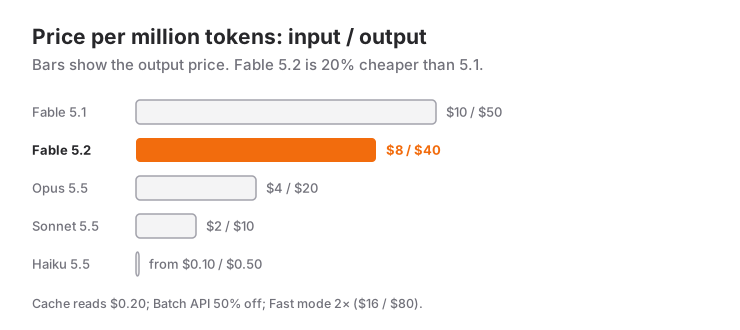
Claude Fable 5.2's API price is $8 per million input tokens and $40 per million output tokens; the Batch API halves that to $4 / $20, and fast mode doubles it to $16 / $80. Cache reads cost $0.20 per million tokens. Anthropic cut Fable 5.1's $10 / $50 by 20% for 5.2, and says that on some benchmarks it matches Opus 5.5's best score at a lower cost per task.
This post is a news roundup and compilation; I have not tested the model. Prices come from Anthropic's developer documentation and the cost claims from the charts on Anthropic's announcement page; I did not read any independent cost-per-task measurement. For a general introduction to the model, see What Is Claude Fable 5.2.
The price table
Per million tokens, in US dollars, per Anthropic's documentation:
| Item | Price |
|---|---|
| Input | $8 |
| Output | $40 |
| 5-minute cache write | $10 |
| 1-hour cache write | $16 |
| Cache read | $0.20 (2.5% of the input price) |
| Batch API | 50% off: $4 input / $20 output |
| Fast mode | $16 input / $80 output (2x standard) |
| US-only inference (data residency) | 1.1x on input and output |
No separate price is given for Mythos 5.2; Anthropic says price and features are the same. What Mythos is and who gets it is in the access post.
The discount versus Fable 5.1
Fable 5.1 cost $10 per million input tokens and $50 for output. Fable 5.2 costs $8 and $40: a 20% drop on both items. According to Anthropic's product page, FrontierSWE v2 rose from 56.3% to 69.9% in the same release, so on Anthropic's own measurement the score went up while the price went down. What to watch when migrating is in the migration post.
Effort levels: which one to choose
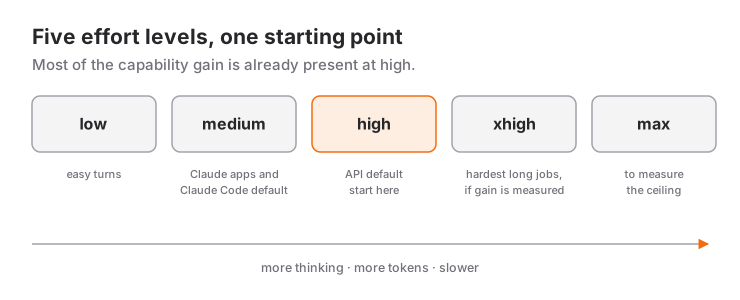
Effort has five levels: low, medium, high, xhigh and max. Adaptive thinking is always on in Fable 5.2 and cannot be turned off; it is the only thinking mode. The model decides how much to think, and effort steers that.
| Level | Anthropic's guidance |
|---|---|
low |
Easy turns; matches Opus 5.5's top score on Humanity's Last Exam (see below) |
medium |
Default in the Claude apps and Claude Code; uses fewer tokens than Fable 5.1 on hard tasks |
high |
API default. The docs: "Start there, because most of the gain in capability is already present at high" |
xhigh |
The hardest long-running coding and agentic work, if you have measured the gain |
max |
Only to measure the ceiling |
The practical method is the one the docs suggest: start your evals at high and sweep effort up or down. According to the docs, at high and above the model thinks before almost every response, so low effort makes sense for easy turns. There is also this behavior difference: at medium and above, instructions like "answer directly, don't think" do not stop the thinking, so you should control cost with effort rather than with the prompt.
When fast mode is worth it
According to Anthropic, fast mode speeds up generation "up to 2.5x" and costs twice the standard price: $16 input, $80 output. So you pay about 2x for at most 2.5x the speed. That makes sense where latency has a measurable money value (interactive coding with a person waiting), not for batch jobs running in the background.
Fast mode exists only on the Messages API, on the Claude API, Google Cloud and Microsoft Foundry (Anthropic-hosted), and in Claude Code. It is not listed for Amazon Bedrock or Claude Platform on AWS. The fast-mode ID on Foundry is claude-fable-5-2-fast. The routes are in the access post.
Caching, Batch and data residency
- Caching. For a long repeated prefix (system prompt, tool definitions, large context), a write costs $10 once (5 minutes) or $16 (1 hour), and later reads cost $0.20. A read is 2.5% of the standard input price.
- Batch API. 50% off for non-urgent work: $4 / $20. The Batch API 300k output beta is not available on Fable 5.2.
- US-only inference. For data residency, 1.1x on input and output. The pages I read do not say how this combines with the other discounts, so I did not combine and calculate it.
- Data retention. Not a price item, but it affects an enterprise budget: Fable models require 30 days of retention by default.
Cost per task: Anthropic's charts
Token price alone does not decide cost; how many tokens it takes to finish the same job matters too. Anthropic shows this with its own charts on the announcement page. All of the following are Anthropic's claims:
- FrontierCode 2.0, High effort: Fable 5.2 scores 45.3% against Opus 5.5's best of 45.5%, at roughly half the cost per task. At Xhigh it scores 49.1%, the highest among the published models Anthropic tried.
- WANDR, Medium effort: matches Opus 5.5's top score at about 40% of the cost.
- Humanity's Last Exam, Low effort: matches Opus 5.5's top score at less than a tenth of the cost per task.
- Chartography, Medium effort: 66.4%, above Opus 5.5 at Max (64.4%), at less than a tenth of the cost.
Note: these are Anthropic's own charts. I did not read an independent cost-per-task measurement such as one from Artificial Analysis. Do not assume Fable 5.2 will come out cheaper than Opus 5.5 before you measure it on your own workload.
Fable 5.2, Opus 5.5 and Sonnet 5.5: which for which job
The four-model comparison from Anthropic's documentation:
| Model | Context / output | Price (per million tokens, input / output) | Latency | Default effort |
|---|---|---|---|---|
| Claude Fable 5.2 | 1M / 128K | $8 / $40 | Moderate | high |
| Claude Opus 5.5 | 1M / 128K | $4 / $20 | Moderate | medium |
| Claude Sonnet 5.5 | 1M / 128K | $2 / $10 | Fast | high |
| Claude Haiku 5.5 | 1M / 128K | From $0.10 / $0.50 | Fastest | medium |
The worked example below is an invented but simple scenario: a single request with 100,000 input tokens and 5,000 output tokens. It only shows the multiplication from the price table; it is not a measurement of a real workload.
| Scenario | Calculation | Total |
|---|---|---|
| Fable 5.2, standard | 0.1 x $8 + 0.005 x $40 = $0.80 + $0.20 | $1.00 |
| Fable 5.1 (for comparison) | 0.1 x $10 + 0.005 x $50 = $1.00 + $0.25 | $1.25 |
| Fable 5.2, Batch API | 0.1 x $4 + 0.005 x $20 = $0.40 + $0.10 | $0.50 |
| Fable 5.2, fast mode | 0.1 x $16 + 0.005 x $80 = $1.60 + $0.40 | $2.00 |
| Fable 5.2, US-only inference | $1.00 x 1.1 | $1.10 |
| Fable 5.2, 80,000 of the input read from cache | 0.08 x $0.20 + 0.02 x $8 + $0.20 = $0.016 + $0.16 + $0.20 | $0.376 |
| Opus 5.5, standard | 0.1 x $4 + 0.005 x $20 = $0.40 + $0.10 | $0.50 |
| Sonnet 5.5, standard | 0.1 x $2 + 0.005 x $10 = $0.20 + $0.05 | $0.25 |
The cached row assumes the cache has already been written. Writing 80,000 tokens to the 5-minute cache on the first request costs $0.80, making that request $0.80 + $0.16 + $0.20 = $1.16. Two requests total $1.536, versus $2.00 for two uncached requests.
Per token, Opus 5.5 is half the price; Fable 5.2 can only come out cheaper per task if it spends fewer tokens, as in Anthropic's charts above. Which model for which job: for hard, long-running agentic and reasoning work, Fable 5.2's benchmark advantages are in the comparison post. If speed and price come first, Sonnet 5.5 may be the better candidate (Sonnet 5.5 post); Sonnet 5.5 is not in Anthropic's Fable 5.2 benchmark table, so I cannot compare the two on benchmarks.
Ways to lower cost
Only the routes Anthropic documents:
- Pick effort by the job. Start at
highand sweep with evals. Uselowormediumfor easy turns, because athighand above the model thinks before almost every response. - Use caching. Reads on repeated prefixes cost $0.20.
- Send non-urgent work to Batch. 50% off.
- Turn on fast mode only if latency has value. It costs 2x.
- Watch the number of sub-agents. According to the docs, the model hands off to sub-agents readily when prompts invite it, and sub-agents can be a large share of session cost.
- Try
mediumon hard tasks. According to Anthropic,mediumeffort uses fewer tokens than Fable 5.1 on hard tasks.
Frequently Asked Questions
How much does the Claude Fable 5.2 API cost?
$8 per million input tokens and $40 per million output tokens. Cache reads are $0.20, 5-minute cache writes $10 and 1-hour writes $16. Prices are per Anthropic's developer documentation.
Is Fable 5.2 cheaper than Fable 5.1?
Yes. Fable 5.1 cost $10 per million input tokens and $50 for output; Fable 5.2 costs $8 and $40, a 20% drop on both items. Anthropic's product page states this cut.
How much does fast mode cost?
$16 input and $80 output, twice the standard price. Anthropic says generation speeds up "up to 2.5x." Fast mode is available only on the Messages API and on certain platforms.
How big is the Batch API discount?
50%. On Fable 5.2 Batch costs $4 input and $20 output. The Batch API 300k output beta is not offered for Fable 5.2.
Which effort level should I choose?
Anthropic makes high the API default and suggests starting there, because most of the capability gain is already present at high. Use xhigh for the hardest long-running work if you have measured the gain, and max only to measure the ceiling. The default in the Claude apps and Claude Code is medium.
Is Fable 5.2 cheaper than Opus 5.5?
Not per token: Opus 5.5 is $4 / $20 and Fable 5.2 is $8 / $40. Anthropic says that on some tasks Fable 5.2 is cheaper per task because it uses fewer tokens (about half on FrontierCode 2.0). Those are Anthropic's own charts; there is no independent measurement.
Is Mythos 5.2 priced differently?
Anthropic gives no separate price and says price and features are the same as Fable 5.2. Mythos is open only to verified organizations.
Sources
- Anthropic, Models overview: Claude Fable 5.2: price table, cache and Batch items, fast-mode and data-residency multipliers, effort levels, four-model comparison.
- Anthropic, Claude Fable 5.2 and Claude Mythos 5.2 (November 9, 2026): cost-per-task charts, default effort, launch information.
- Anthropic, Claude Fable product page: the 20% price cut versus Fable 5.1.
- Anthropic, What's new in Claude Fable 5.2: notes on effort and thinking behavior, the warning about sub-agent cost.
Related Posts
What Is Claude Fable 5.2? Price, Mythos, Access
Anthropic released Claude Fable 5.2 on Nov 9, 2026: 1M context, $8 input and $40 output per million tokens, 20% cheaper than Fable 5.1.
Claude Fable 5.2 vs Opus 5.5, GPT-6 Astra, Gemini 4 Carbon
Anthropic's table has Claude Fable 5.2 ahead on 10 of 11 benchmarks against Opus 5.5, GPT-6 Astra and Gemini 4 Carbon. Where it trails, and how to read it.
What Can Claude Fable 5.2 Do? 1,000 Agents, Fermat
According to Anthropic, Claude Fable 5.2 built an OS with 1,000 agents, formalized Fermat's Last Theorem in 30 hours, and solved two open physics problems.