
LongCat 2.5 Preview and Competing AI Models
9 min read
Meituan has released LongCat-2.5-Preview, and the open-weights race is heating up again. The family has moved from an in-house research line built around long-context agentic coding to an ecosystem that publishes official guides for twelve different tools.
The real story of this news is not one model's capabilities but a structural shift. Three things became true at once: a one-million-token context is no longer a distinguishing feature, thinking modes are becoming optional, and open-weights models are closing the price gap with closed flagships.
This article brings three things together: the benchmark scores LongCat published itself, the technical specifications of every model involved, and how those scores should be read.
An opening warning: this is a news report, not an independent test. The scores below come from LongCat's own model card and are LongCat's own measurements. A significant part of the comparison columns, however, was not measured by LongCat at all but quoted from the competitors' own reports. I explain why that distinction matters halfway through.
The published benchmark table
LongCat publishes a table in its model card comparing itself with rival models. I reproduce it as it stands, because the most common mistake in a news piece is to reshape the source table:
| Benchmark | LongCat-2.0 | Gemini 3.1 Pro | GPT-5.5 | Claude Opus 4.6 | Claude Opus 4.7 | Claude Opus 4.8 |
|---|---|---|---|---|---|---|
| Terminal-Bench 2.1 | 70.8 | 70.7* | 73.8* | - | 71.7* | 78.9* |
| SWE-bench Pro | 59.5 | 54.2* | 58.6* | 57.3* | 64.3* | 69.2* |
| SWE-bench Multilingual | 77.3 | 76.9* | - | 77.8* | 80.5* | 84.8* |
| FORTE | 73.2 | 70.3 | 77.8 | 73.2 | 77.6 | 77.2 |
| BrowseComp | 79.9 | 85.9* | 84.4* | 84.0* | 79.3* | 84.3* |
| RWSearch | 78.8 | 76.3 | 85.3 | 81.3 | 79.3 | 77.3 |
| IFEval | 90.0 | 96.1 | 95.0 | 92.2 | 88.7 | 86.0 |
| Writing Bench | 83.8 | 83.7 | 84.7 | - | 85.3 | 85.2 |
| IMO-AnswerBench | 81.8 | 90.0 | 79.5 | 75.3* | 81.8 | 75.3 |
| GPQA-diamond | 88.9 | 94.3* | 93.6* | 91.3* | 94.2* | 92.4* |
LongCat's own note: the asterisk (*) means "cited from that model's official report". So LongCat's scores were measured in-house, while the competitors' scores come from their own measurements.
How to read this table
News pieces usually present a benchmark table as a ranking. That would be misleading here, because the asterisks mark exactly the weakest point of the comparison.
The problem: LongCat's score was measured on its own hardware, in its own harness, with its own prompt template. The competitor's score was measured on that competitor's hardware, in its own harness. Those two measurements were not taken in the same lab. Running the same model in two different places does not give the same score; that is a property of the measurement, not of the model.
The second problem: some competitor cells are empty. The Claude Opus 4.6 column has "-" for Terminal-Bench, meaning "no comparable public score". LongCat did not know the score there, which is a sign of restraint rather than a score in its own favour.
The third and most important problem: the rows do not point one way. LongCat is ahead in some coding and agent rows and behind in others. On Terminal-Bench 2.1 it is ten points behind Claude Opus 4.8, but on FORTE it is three points ahead of Gemini 3.1 Pro. On IFEval its 90.0 is the second highest value in the table; on GPQA-diamond its 88.9 is among the lowest.
That mixed table delivers the actual message of the news: LongCat is not a model specialised in one area, but one sitting inside the same broad band as its rivals. Nobody can say "LongCat beat Codex" or "LongCat leads deep research". The accurate phrasing is: competitive in coding agents, behind on foundational reasoning.
Is the long-context race over
Look at the specification table and the picture is this:
| Model | Context | Max output | Input modalities | In $ / M | Out $ / M |
|---|---|---|---|---|---|
LongCat-2.5-Preview |
1,048,576 | 131,072 | text, image | $0.30 | $1.20 |
meituan/longcat-2.0 |
1,048,756 | 262,144 | text | $0.30 | $1.20 |
openai/gpt-6-luna |
1,050,000 | 128,000 | text, image, files | $0.10 | $0.50 |
google/gemini-3.8-flash |
1,048,576 | 65,536 | text, image, video, files, audio | $0.75 | $3.75 |
anthropic/claude-opus-5.5 |
1,000,000 | 128,000 | text, image, files | $4.00 | $20.00 |
stealth/space-bunny-alpha |
1,000,000 | 524,288 | text, image, video | $0 | $0 |
All six models offer a context window around a million tokens. That confirms the observation in the comparison article: a million tokens is no longer a feature, it is an expectation. Competition has shifted from how big the window is to how the model uses it.
LongCat's difference here is not the window but the mechanism behind it. Sparse attention lets it use a 1M window without comparing every token pair. The quadratic cost problem described in the 1M context article shrinks when sparse attention is present. The window is the same; the cost is not.
The thinking mode front
This is the most visible change of the past months. There are three approaches:
Non-switchable reasoning. Space Bunny Alpha makes it mandatory, with max as the default tier. Claude Opus 5.5 cannot switch it off either, but defaults to high. Wanted on long answers, unnecessary on simple tasks.
Optional reasoning. LongCat-2.5-Preview takes thinking as enabled or disabled, defaulting to enabled. Gemini 3.8 Flash also cannot switch it off. This is the most useful behaviour for someone building a production system: you can turn it off for simple classification and escape the latency.
Switchable reasoning. GPT-6 Luna offers a none tier and defaults to medium. You decide per call rather than per model.
The practical result: for long-running agent loops, the "which tool should I pick" question from the vibe coding article now carries an extra question: with the model you picked, how much thinking are you letting it do? Tuning the thinking tier per turn is the general version of what the agent article does in its example.
The price front
Let us run the same scenario across all six models. One turn with 200,000 input tokens and 50,000 output tokens, thirty turns a month:
| Model | Per turn | Monthly | Monthly with cached input |
|---|---|---|---|
stealth/space-bunny-alpha |
$0.00 | $0.00 | $0.00 |
openai/gpt-6-luna |
$0.045 | $1.35 | $1.20 |
LongCat-2.5-Preview |
$0.1200 | $3.60 | $1.76 |
google/gemini-3.8-flash |
$0.3375 | $10.13 | $10.13 |
anthropic/claude-opus-5.5 |
$1.80 | $54.00 | $53.65 |
The last column is the real version of LongCat thanks to its cached price: $1.76 instead of $3.60. GPT-6 Luna has a cached price too, and the drop there is smaller.
This ranking completes the third leg of the story. The price advantage of closed flagships is turning into a price advantage for open models among previews. While Claude Opus 5.5 costs $54 a month, LongCat-2.5-Preview offers the same context for $1.76. That is not a price war, it is a change of economic class.
One caveat in a single sentence: LongCat's $0.30 price is also listed as a limited-time discount. As the Space Bunny Alpha comparison explains, today's price list is not tomorrow's.
The transparency front
This is where LongCat is strongest and weakest at the same time.
Strong: LongCat is a company, so a legally identifiable counterparty. There is a model card, an open license (MIT), a technical blog and a GitHub repository. The architecture of a 1.8-trillion-parameter model is explained as sparse attention plus N-gram embedding. The quantized versions of LongCat-2.0 are downloadable.
Weak: for LongCat-2.5-Preview the weights are not published. So "LongCat is open source" is not accurate without naming the version. Today's reality is that the preview is reachable only through the API.
On the other side, Space Bunny Alpha's situation is the exact reverse: zero price, a million context, video input, but no company, no license, no weights and no knowledge cutoff.
So two extremes on the same axis:
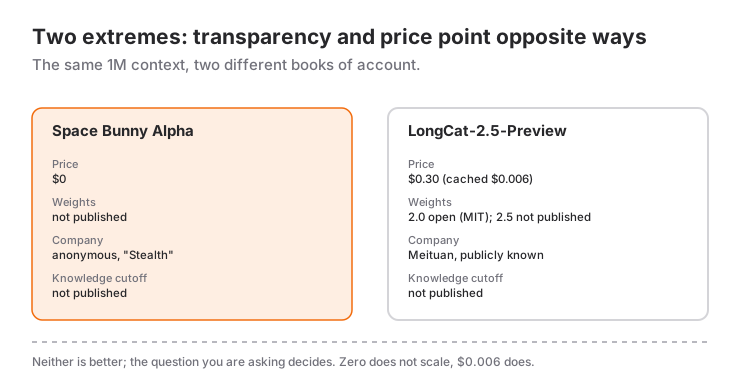
| Transparency | Price | Context | Image/video | |
|---|---|---|---|---|
| Space Bunny Alpha | none | $0 | 1M | text, image, video |
| LongCat-2.5-Preview | limited (no weights) | $0.30 | 1M | text, image |
This is why "which one is better" depends on the question you are asking, not on the model name. The split described in the JEV article applies here too: a model is a function that takes text and returns text, and deciding what to use it for is your job.
What this news means
In three sentences:
One. Long context has lost its first-class status. Six of six rivals offer a million tokens. The question is no longer "how many tokens" but "which mechanism selects those tokens".
Two. The thinking tier has become a new line item on the bill. Building a long agent loop without setting reasoning_effort or thinking is guessing at your own invoicing.
Three. Open-weights models have caught up with closed rivals on context and multimodal capability; the difference is now price and breadth of integration. LongCat's most concrete win is this: publishing official guides for twelve tools is more useful than any technical specification.
Sources
- Hugging Face: meituan-longcat/LongCat-2.0 model card (benchmark table and asterisk explanation, sparse attention, N-gram embedding, MIT license)
- LongCat pricing: LongCat-2.5-Preview (cached input $0.006, uncached $0.30, output $1.20)
- LongCat API documentation: Retrieve Model (context length, supported parameters,
thinking) - Vercel AI Gateway: LongCat 2.5 Preview (max output, model id, multimodal description)
- OpenRouter model API (context, price, input modalities and reasoning tiers for the competing models)
- LongCat tool guides (Claude Code, Codex, opencode, Cline and other integrations)
Related Posts
How to Install LongCat 2.5 Preview: News and Guide
Meituan's LongCat-2.5-Preview is out: 1M context, image input, optional thinking mode and $0.006 cached input. Here is the step-by-step setup.
Space Bunny Alpha vs Other AI Agents
Space Bunny Alpha compared with Claude, GPT, Gemini and free open models: price, the 1M context window, multimodal input and agent capabilities.
Space Bunny Alpha: 1M Context and Multimodal Input
What a one-million-token context window really holds, how image and video input share that budget, and how to measure and manage your token budget.