What Is Antigravity Orchestrator? Carbon Plans, Hydrogen Codes
10 min read

Orchestrator is an option added to Google Antigravity's model menu on November 12, 2026: it plans the work with a large model (Gemini 4 Carbon or Argon) and writes and tests the code with Gemini 4 Hydrogen. In Google's words, it "dynamically switches between models like Carbon and Hydrogen within the same session." So instead of picking a single model, you pick an arrangement in which the expensive model thinks and the fast model executes.
This post is a news roundup and compilation; I have not tested Orchestrator myself. What I describe is based on Google's Antigravity blog post, the Antigravity docs and the Hydrogen announcement; the measurement figures are Google's own. Sources are at the end. For the models themselves, see What Is Gemini 4 Hydrogen? and What Is Gemini 4 Carbon?.
At a glance
| Feature | Value |
|---|---|
| What | An option in Antigravity's model menu that switches between models on its own |
| Launched | November 12, 2026 (same day as Gemini 4 Hydrogen) |
| Variants | Orchestrator (Carbon), Orchestrator (Argon) |
| Planning model | Carbon or Argon |
| Executing model | Hydrogen |
| Who gets it | Orchestrator (Carbon): Google AI Ultra. Orchestrator (Argon): Ultra and Pro |
| Thinking level | Fixed, cannot be chosen |
| Google's measurement | Near-Carbon success rate, 24% less quota on average, 19% faster |
Antigravity is Google's agent-first development environment. Orchestrator is not a model; it is a way of working that uses existing models in turn.
How does it work?
The typical flow, as Google describes it:
- Planning. The big model (Carbon) starts in a read-only planning phase. Read-only means it does not change files at this stage.
- Execution. Hydrogen takes over: it writes the edits and runs the tests.
- Handing back. If Hydrogen hits friction, control goes back to Carbon.
All of this happens in the same session; you do not switch the model yourself.
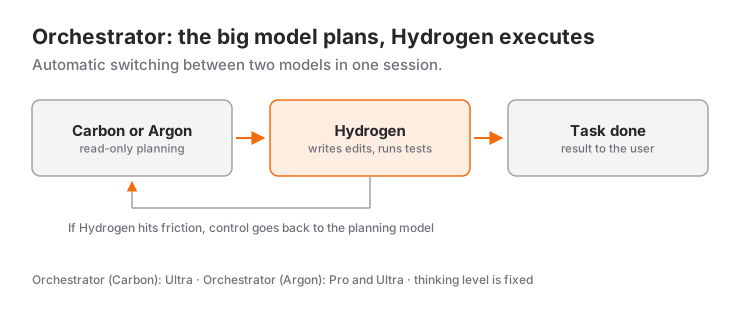
This is the "planner + executor" pattern known from software agents: the expensive model thinks, the cheap and fast model does. A similar arrangement can be wired up by hand in other tools. What is new here is that the pattern is built into the product as a ready-made menu option.
Two variants, and who gets which
The model table in the Antigravity docs has two rows:
- Orchestrator (Carbon): plans with Carbon, implements with Hydrogen. Google AI Ultra only.
- Orchestrator (Argon): plans with Argon, implements with Hydrogen. Ultra and Pro (paid Pro, or a trial with eligible premium devices).
The relevant rows from the same table (checked November 14, 2026):
| Plan | Orchestrator (Carbon) | Orchestrator (Argon) | Carbon on its own | Argon on its own | Hydrogen |
|---|---|---|---|---|---|
| Free | No | No | No | No | Yes |
| Google AI Plus | No | No | No | No | Yes |
| Google AI Pro | No | Yes | No | Yes | Yes |
| Google AI Ultra | Yes | Yes | Yes | Yes | Yes |
| Enterprise | No | No | Yes | Yes | Yes |
The "Yes" entries in the Pro row apply to paid Pro or the eligible-device trial. Three conflicts to know about when reading the table:
- Enterprise. The Antigravity blog post says enterprises can access both Orchestrator variants in Gemini for business. The docs table shows both rows as unavailable for Enterprise. I do not know which is current; if you have an enterprise account, check your own model menu.
- Hydrogen on the free plan. The Hydrogen announcement and the Antigravity blog say "paid Google AI Pro and Ultra subscribers"; the docs table shows Hydrogen on every plan, including Free and Plus. The details are in Is Gemini 4 Hydrogen Free?.
- The "Ultra only" report. DataCamp wrote that Orchestrator is "initially limited to Ultra." The docs table shows the Argon variant on Pro as well. I went with the docs.
Google says additional models and plans will be supported in the future. For how Argon works on Pro in Antigravity, see the Argon access post.
What did Google measure?
According to Google, on Terminal-Bench 4.1 Orchestrator reached "near-Carbon task success rates" while using on average 24% less quota and finishing 19% faster. I read this as a comparison with Carbon on its own.
Keep these in mind when reading that result:
- No absolute score. How many points "near-Carbon" means is not stated.
- The version is inconsistent. The Antigravity post says Terminal-Bench 4.1 for this result; the Hydrogen announcement says Terminal-Bench 4.0 for the same claim. Google's methodology document says it reports cost-versus-performance comparisons on Terminal-Bench 4.0 because competitor data across thinking levels was not available for 4.1; it does not say separately which version the Orchestrator measurement used.
- A single source. This is Google's own measurement; I have not seen an independent repeat.
- A single benchmark. Terminal tasks need not represent all the work in your codebase.
Why does planner + executor make sense?
This section is my interpretation.
On Artificial Analysis's general index (v5.0.1, high level), the per-task figures for the two models are:
| Model (high) | Index | Cost per index task | Time per task |
|---|---|---|---|
| Gemini 4 Carbon | 60 | $5.48 | 29.0 min |
| Gemini 4 Hydrogen | 51 | $1.87 | 7.8 min |
These numbers are from a general index, not from Antigravity; I give them only to show the size of the gap between the two models. Carbon is nine points ahead, but costs roughly three times as much per task and takes about 3.7 times as long.
Not every step of a coding job is equally hard. Deciding what changes, in which file and in which order is the hard part. Once that is decided, editing the file, running the test, reading the error and trying again is usually more mechanical, and there is far more of it. Giving the strong model the hard, infrequent steps and the fast model the frequent, mechanical ones lowers both quota use and waiting time. Google's 24% and 19% are consistent with that logic.
One more data point: on SWE-sweep, which measures repairing bugs without breaking existing code, Google's tables show Hydrogen at 13.5% and Carbon at 9.6%. The two values come from separate tables, so read them with care; but they suggest Hydrogen is not the weak link in the execution step. All the figures are in the Hydrogen comparison post.
Arrangements like this also carry a general risk: information can get lost when work is handed from one model to another, and the executing model may not know why the plan was built the way it was. Orchestrator has the step that hands control back to Carbon on friction; how context is passed between the models is not described in the sources for this post. I have also not seen independent data on how well these handoffs work in real projects. I explained how this kind of setup around a model changes the result in the post on what a harness is.
Sub-agents and the SDK example
The same idea is applied to sub-agents. In Google's words, "Carbon can act as the coordinator while Hydrogen can power worker and verifier agents."
The Antigravity SDK ships with an open-source example of this: an issue-triage demo. In it, Hydrogen agents triage issues and write code, while a Carbon agent handles refactors and security checks. If you want to build the same arrangement with your own agents, this example is the starting point.
Limits and open questions
- The configuration is fixed. You cannot choose the thinking level in Orchestrator. In the API, Hydrogen supports the low, medium, high and xhigh levels; Orchestrator offers no such choice.
- No quota numbers. Antigravity's plans page gives no figures. For Ultra it says "the highest, most generous quota, refreshed every five hours"; for Pro "a high, generous quota, refreshed every five hours until the weekly limit is reached"; for everyone else "a meaningful quota, refreshed weekly." It also says harder tasks consume more quota. Pro and Ultra subscribers can buy AI credits for overages.
- How many tasks "24% less quota" means for you is unknown. Because no numbers are published, you cannot calculate it; you have to watch your own usage.
- Free and Plus are left out. Neither Orchestrator variant is on these plans.
- Enterprise is unclear. The blog and the docs conflict (see above).
- The measurement comes from one party. A vendor result on a single benchmark, with no absolute score.
A calendar note as well: according to the Antigravity docs, Claude Sonnet 4.6, Claude Opus 4.6 and GPT-OSS-120b are removed from the model menu on November 18, 2026. If your menu changes on that date, that is why.
Which to pick: Orchestrator, Hydrogen or Carbon?
This is also my interpretation.
- Orchestrator: work that touches several files, needs a plan, and involves many edit-and-test loops. If you want to make your quota last, it is a good candidate instead of running Carbon from start to finish.
- Hydrogen on its own: small, well-defined jobs: a single function, a bug fix, writing a test. According to the docs table, it is the only Gemini 4 option on the Free and Plus plans anyway.
- Carbon on its own: work where every step needs the strong model: the root cause of a subtle bug, a security review, long-running investigation. It is on Ultra and Enterprise only; going by Google's measurement, it uses more quota than Orchestrator.
- If you are on Pro: there is no Carbon; you choose between Orchestrator (Argon) and Argon on its own.
Frequently Asked Questions
What is Antigravity Orchestrator?
An option in Google Antigravity's model menu. In a single session it plans with a large model (Carbon or Argon), writes and tests the code with Hydrogen, and goes back to the large model when it gets stuck.
Which plans include Orchestrator?
According to the Antigravity docs, Orchestrator (Carbon) is on Google AI Ultra only; Orchestrator (Argon) is on Ultra and Pro. Neither is on the Free or Google AI Plus plans.
What is the difference between Orchestrator (Carbon) and Orchestrator (Argon)?
The planning model: Carbon in one, Argon in the other. In both, the executing model is Hydrogen.
Is Orchestrator as successful as Carbon?
Google says it reached near-Carbon task success rates on Terminal-Bench while using 24% less quota and finishing 19% faster. No absolute score has been published, and this is Google's own measurement.
Can I choose the thinking level in Orchestrator?
No, the configuration is fixed. Google does not offer a thinking-level choice for Orchestrator.
Can I use Orchestrator in the API?
Google presents it as an option in Antigravity's model menu; the sources for this post do not mention a separate Orchestrator model for the API. To build a similar arrangement in your own code, you can look at the open-source example in the Antigravity SDK.
Sources
- Google DeepMind, Gemini 4 Hydrogen: Model evaluation (November 2026): why Terminal-Bench 4.0 and 4.1 are both used.
- Google Antigravity, Gemini 4 Hydrogen and Orchestrator: definition of Orchestrator, the flow, the 24% and 19% measurement, sub-agents and the SDK example.
- Google Antigravity docs, Choose a model (checked November 14, 2026): plan and model table, Orchestrator variants, models being removed.
- Google Antigravity docs, Plans (checked November 14, 2026): quota wording, AI credits.
- Google, Introducing Gemini 4 Hydrogen (November 12, 2026): Orchestrator announcement, Terminal-Bench 4.0 wording for the same measurement.
- Google DeepMind, Gemini models page: SWE-sweep values.
- Artificial Analysis, model leaderboard: index, cost and time per task for Carbon and Hydrogen.
- DataCamp, Gemini 4 Hydrogen (November 13, 2026): the note that Orchestrator is initially limited to Ultra.
Related Posts
What Is Gemini 4 Hydrogen? Specs, Price, Benchmarks
Google opened Gemini 4 Hydrogen to everyone on Nov 12, 2026: a 1M-token window, $1.50 input pricing and a free API tier. Specs and measurements in one place.
Gemini 4 Carbon Is Out: Who Can Use It and How
Gemini 4 Carbon has been generally available since Nov 10, 2026: paid API developers and Google AI Ultra subscribers get it; Pro, Plus and free users do not.
Migrating from Gemini 3.8 Flash to Gemini 4 Hydrogen
Moving from Gemini 3.8 Flash to Hydrogen takes more than a new model name: minimal, explicit caching, sampling parameters and the output cap changed too.