What Is Gemini 4 Hydrogen? Specs, Price, Benchmarks
15 min read
Gemini 4 Hydrogen is the fast, lower-cost model of the Gemini 4 family, announced by Google on November 12, 2026 and made generally available the same day. Its API model ID is gemini-4-hydrogen; there is no preview suffix, it went straight to general availability. Google presents it as "our daily driver for agentic workflows." The other two family members, Argon and Carbon, are tied to paid plans; Hydrogen is the only Gemini 4 model with a free API tier.
This post is a news roundup and compilation. The small test in which I tried the model on one task at four thinking levels is in a separate post: I tested Hydrogen. The numbers in this post are not my own measurements. The numbers come from Google's announcement, the model card, the AI Studio docs and third-party pages such as Artificial Analysis. I checked the pricing and docs pages on November 14, 2026; those pages can change. Sources are at the end. The details are in separate posts: Is Gemini 4 Hydrogen free, and who can use it, the Hydrogen, Claude Sonnet 5.5 and GPT-6.1 Terra comparison, What is Antigravity Orchestrator and Migrating from Gemini 3.8 Flash to Hydrogen.
Is there a "Gemini 4 Flash"?
No, there is no model with that name. On none of Google's pages is "Flash" part of this model's name; the official name is Gemini 4 Hydrogen. On the other hand, the AI Studio docs describe Hydrogen as the "recommended upgrade from Gemini 3.8 Flash and earlier Gemini 3 and 2.5 models." So Hydrogen sits where Flash sat in the previous generation. It is the same situation as the model people call "Gemini 4 Pro," whose official name is Argon.
Saying that Hydrogen "replaces" 3.8 Flash goes too far, though. The gHacks headline and DataCamp say "replaces"; Google's own wording is "recommended upgrade." The API release notes also have no deprecation or shutdown entry for gemini-3.8-flash.
The news at a glance
| Feature | Value |
|---|---|
| Model name | Gemini 4 Hydrogen |
| Announced and generally available | November 12, 2026 (same day) |
| API model ID | gemini-4-hydrogen |
| Context window | 1,048,576 tokens; input, thinking and output share one window |
| Max output | 65,536 tokens by default; up to 1,048,576 with background "long decode" |
| Input types | Text, image, video, audio, PDF |
| Output | Text only |
| Thinking levels | low, medium, high (default), xhigh |
| Knowledge cutoff | March 2026 |
| API price (standard) | $1.50 input, $7.50 output per million tokens |
| Cached input | $0.075 per million tokens (implicit caching, 95% off) |
| Free tier | Yes, rate limited |
| Where | Gemini API and AI Studio, Gemini app, AI Mode in Google Search, Antigravity, Google Sheets, Chrome, Android Studio |
According to the model page in AI Studio, Hydrogen supports thinking, function calling, structured outputs, code execution, computer use, file search, grounding with Google Search and Google Maps, URL context, agentic video understanding, implicit context caching, the Batch API, Flex and Priority. It does not support explicit context caching, image generation, audio generation or the Live API.
There are two changes in the thinking levels. The xhigh level arrived with Hydrogen; Carbon and Argon stop at high and default to medium. Hydrogen defaults to high. minimal is not accepted and returns an error.
How it relates to Carbon and Argon
The model card gives the relationship in one sentence: "Gemini 4 Hydrogen is adapted from Gemini 4 Carbon." The card defers to Carbon's card for training and architecture details; no parameter count has been published.
Google AI's post on X describes the division of labor this way: Carbon tackles the hardest problems, while Hydrogen "brings cutting-edge intelligence to everyone" with speed and efficiency for everyday coding and agentic workflows.
The timeline: Argon was announced on September 30 (generally available October 13), Carbon on October 28 (generally available November 10), and Hydrogen was announced and opened on November 12. Hydrogen has no staged release and no Fairwind gate.
| Model | Role | API price (per million tokens, input / output) | Who can use it |
|---|---|---|---|
| Gemini 4 Carbon | The hardest problems | $2 / $10 through November 30, $4 / $20 from December 1 | Paid API; Google AI Ultra subscribers in the Gemini app, Antigravity and AI Mode |
| Gemini 4 Argon | Long-running work | $2 / $10 through November 30, $4 / $20 from December 1 | Paid API; Google AI Pro and Ultra in the Gemini app |
| Gemini 4 Hydrogen | Fast everyday coding and agentic work | $1.50 / $7.50 | Free and paid API; Gemini app and Google Search (details below) |
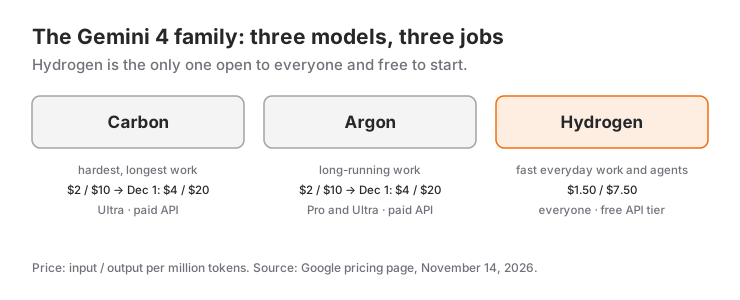
Carbon has been generally available since November 10, but it is not on the free tier, and neither is Argon. "Gemini 4 for everyone, for free" is true only for Hydrogen.
On the same day as Hydrogen, Google Antigravity gained a new model option called Orchestrator. It switches between models within the same session: the big model starts in a read-only planning phase, Hydrogen writes the edits and runs the tests, and if it hits friction, control goes back to the big model. Which variant is open on which plan, and what Google measured, is in What is Antigravity Orchestrator.
Benchmark results
Google compares Hydrogen with Claude Sonnet 5.5 and GPT-6.1 Terra. The table in the announcement is an image; I took the values below from the text table on Google DeepMind's Gemini models page ("as of November 2026").
| Benchmark | Hydrogen | Claude Sonnet 5.5 | GPT-6.1 Terra |
|---|---|---|---|
| SWE-sweep (find and repair bugs without breaking existing code) | 13.5% | 3.1% | 5.8% |
| Terminal-Bench 4.1 (cheating-adjusted) | 57.0% | 63.9% | not given |
| Agents' Last Exam v1.1 (end-to-end professional workflows) | 71.6% | 60.4% | 69.8% |
| AutomationBench-AA | 76.1% | 71.8% | 60.2% |
| Vending-Bench 2 (bank balance) | $14,549 | $11,165 | $9,107 |
| OSWorld-2.1 (offline subset, computer use) | 77.6% | 83.9% | 74.2% |
| MKA, Multimodal Knowledge Agent | 53.4% | 52.0% | 43.8% |
| Chartography | 66.6% | 61.6% | 63.2% |
| Terminal-Bench-Science 0.1 | 51.4% | 59.9% | 58.3% |
| HLE-Diamond | 58.8% | 53.3% | 47.3% |
Three things to keep in mind when reading the table:
- Hydrogen leads 7 of the 10 rows. Claude Sonnet 5.5 leads on Terminal-Bench 4.1, OSWorld-2.1 and Terminal-Bench-Science. So terminal-based agents and computer use are where Hydrogen trails.
- Most competitor numbers are not Google's own runs. According to Google's evaluation methodology document, Hydrogen's scores are single-attempt results obtained through the Gemini API; the numbers for non-Google models are, unless stated otherwise, the vendors' self-reported values or figures from official leaderboards. So the table is not one experiment run side by side under identical conditions. The row-by-row breakdown is in the comparison post.
- There is a version trap. This table uses Terminal-Bench 4.1; Carbon's table used 4.0 (Carbon 65.2%, Argon 57.1%). Do not put the two versions in one column.
The announcement text also gives these numbers: 51 on the Artificial Analysis Intelligence Index at the default high level (Argon 50) and 54 at xhigh; 57% on Terminal-Bench 4.1 versus 18.2% for Gemini 3.8 Flash (Google says "more than tripling"); 52.3% on Vals Tax Agent Bench, first overall; 55.8% on Vals Legal Research Bench, tied for first; fifth on Agent Arena.
A note on the family: in Google's Carbon table the SWE-sweep value is 9.6%; Hydrogen's 13.5% is higher than Carbon's on this one benchmark. On the other shared rows Carbon is ahead (for example 81.5% on OSWorld-2.1). These are two separate tables; read each on its own. The row-by-row reading is in the comparison post.
The claims Google highlights
All of the following are comparisons with Gemini 3.8 Flash, measured by Google or its partners; no method has been published.
Speed. According to Google, Hydrogen finishes tasks 2.5 times faster at the default high setting. Early partner tests reported 2 to 2.8 times the speed with 12% to 23% fewer tokens on complex graphs, SQL and data-heavy workflows. In Sheets, canvas outputs are more than 30% faster than with previous models.
Behavior.
- Fabricated claims were cut by more than 5 times.
- Overreach fell by up to 81% and under-service by up to 79%.
- Misaligned actions and task shortcutting were cut 12 times.
- It is up to 2 times less likely to bypass permission boundaries.
- It is more than 2.3 times more resilient on the Gray Swan indirect prompt-injection benchmark.
- A 94% honesty rate on an internal evaluation; 99.9% chain-of-thought legibility over more than 200,000 audited turns; false refusals on HealthBench Pro under 0.4%.
The caveat in the model card. In automated safety comparisons, unjustified refusals got worse by 5.57 percentage points compared with 3.8 Flash. In the same comparison, text-to-text safety improved by 0.80, multilingual safety by 1.10 and image-to-text safety by 7.00 percentage points. In other words, the model may turn down some harmless requests more often than its predecessor.
Frontier safety evaluation. According to the model card, Hydrogen brings no material increase in general capability over Argon, so the full critical-capability evaluation suite was not required. Targeted tests found that it does not reach the critical capability levels for CBRN or cyber, but that it reaches the alert thresholds for both; mitigations stay deployed. For the full safety report the card says "coming soon."
What the independent measurements show
The values from Artificial Analysis's Intelligence Index v5.0.1 page:
| Model (thinking level) | Index | Cost per index task | Time per task |
|---|---|---|---|
Hydrogen xhigh |
54 | $3.16 | 14.1 min |
Hydrogen high (default) |
51 | $1.87 | 7.8 min |
Hydrogen medium |
41 | $0.80 | 3.7 min |
Hydrogen low |
27 | $0.29 | 1.3 min |
Gemini 4 Carbon high |
60 | $5.48 | 29.0 min |
Gemini 4 Argon high |
50 | $4.97 | 30.0 min |
On the same page Gemini 3.8 Flash scores 31 at high and takes 14.6 minutes per task. Carbon shows 60 here; Google's October 28 text said 59, because that number belonged to v5.0 of the index.
- The default level matters.
high51,medium41,low27. The drop is steep; saving money by lowering the level also costs points. - It reaches Argon's score for less. At
high, Hydrogen scores 51 and Argon 50; cost per task is $1.87 versus $4.97, and time is 7.8 minutes versus 30.0 minutes. Carbon is clearly ahead at 60. - It is wordy. At
xhighit spent 304 million output tokens to complete the index; the median is 77.3 million. Artificial Analysis calls this "very verbose." It produces 182 output tokens per second, and the time to the first answer token is 42.9 seconds (16.3 seconds athigh). - The hallucination rate is 8.5%. That is the AA-Omniscience value BenchLM cites from Artificial Analysis (accuracy 50.5%); DataCamp writes "8%." The rate is how often the model gives a wrong answer instead of saying it does not know; lower is better. In my earlier posts, Argon was at 4% and Carbon at 11% on the same benchmark. Google's "fabricated claims cut by more than 5 times" is its own measurement against 3.8 Flash; the two measure different things.
- It trails on terminal work. As DataCamp reports, in Artificial Analysis's own Terminal-Bench 4.0 run Hydrogen scores about 54% (BenchLM lists 53.5%), Claude Sonnet 5.5 64% and GPT-6.1 Sol 56%. DataCamp's conclusion: "not the best model available for terminal-heavy work."
Price
On the standard tier it is $1.50 per million input tokens and $7.50 for output; cached input is $0.075. Batch and Flex cost half ($0.75 / $3.75), and Priority is $2.70 / $13.50. The price is flat across the whole 1M window, with no long-context surcharge; there is no promo period for Hydrogen either. Every processed token is billed, including thinking tokens.
For comparison: Gemini 3.8 Flash is $0.75 / $3.75 through December 31, 2026, and $1.50 / $7.50 from January 1, 2027. So Hydrogen costs twice what 3.8 Flash costs today, and the same from January. A worked example and all the tiers are in Is Gemini 4 Hydrogen free.
Who can use it?
On the Gemini API and in Google AI Studio everyone can use it, on the free tier and the paid tier. In the Gemini app, free users get Hydrogen through automatic model selection, when it is the appropriate model for the prompt. In AI Mode in Google Search it is open to all users. Google Sheets requires Google AI Pro or Ultra.
For Antigravity the sources disagree: the announcement says "paid Google AI Pro and Ultra subscribers," while two Antigravity docs pages (the plans page and the model table) list Hydrogen on all plans, including the free one. No page explains the difference.
The model cannot be downloaded; no weights have been released, and it runs on Google's servers. The surface-by-surface table is in the access post.
For those moving from Gemini 3.8 Flash
Changing the model name is not enough: the minimal thinking level, explicit caching and the sampling parameters (temperature, top_p, top_k) behave differently or return an error on Hydrogen. The step-by-step list is in the migration guide.
Frequently Asked Questions
What is Gemini 4 Hydrogen?
A Gemini 4 model that Google announced and made generally available on November 12, 2026. According to the model card it is adapted from Gemini 4 Carbon; Google positions it as the fast, efficient model for everyday coding and agentic workflows.
Has Gemini 4 Flash been released?
There is no model with that name. Google's docs describe Hydrogen as the recommended upgrade from Gemini 3.8 Flash; Hydrogen sits where Flash sat in the previous generation.
Is Gemini 4 Hydrogen free?
The API has a rate-limited free tier; in the Gemini app free users get it through automatic model selection, and in Google Search everyone can use it through AI Mode. On the paid API it costs $1.50 per million input tokens and $7.50 for output.
Is Hydrogen better than Argon?
On the Artificial Analysis index it is one point ahead at the default setting (51 to 50), and it is cheaper and faster per task. In return, Argon does better on the same organization's hallucination measurement (4% versus 8.5%), and in Google's tables Argon leads on Chartography (71.6% versus 66.6%).
What is the difference between Hydrogen and Carbon?
Carbon is the strongest model in the family: 60 on the Artificial Analysis index versus Hydrogen's 51. In exchange it spends $5.48 and 29.0 minutes per index task; Hydrogen spends $1.87 and 7.8 minutes. Carbon is not on the free tier.
Can I trust the benchmark results?
Google's table consists of benchmarks Google chose, and according to the methodology document most competitor values are vendor-reported or leaderboard numbers, not runs under identical conditions. The independent measurements paint a different picture on terminal work and verbosity. Try it on your own task before deciding.
Sources
- Google DeepMind, Gemini 4 Hydrogen: Model evaluation (November 2026): how Hydrogen's and the competitors' numbers were obtained.
- Google, Introducing Gemini 4 Hydrogen (November 12, 2026, updated November 13): description, speed and behavior claims, benchmark numbers in the text, access.
- Google, Gemini 4 Hydrogen: everyday coding and agentic workflows for developers: developer surfaces, Android Studio.
- Google, Google Search gets a major upgrade with Gemini 4 Hydrogen: availability to all users in AI Mode.
- Google DeepMind, Gemini 4 Hydrogen model card: adaptation from Carbon, knowledge cutoff, change in unjustified refusals, frontier safety evaluation.
- Google DeepMind, Gemini models page: benchmark table.
- Google AI Studio, Gemini 4 Hydrogen model page: context window, output limit, supported features, thinking levels.
- Google AI Studio, What's new in Gemini 4 Hydrogen: the "recommended upgrade" wording, migration notes.
- Google AI Studio, Gemini API pricing (checked on November 14, 2026): prices for Hydrogen, 3.8 Flash, Argon and Carbon.
- Google AI Studio, Gemini API release notes: model ID, general availability date, no shutdown entry for 3.8 Flash.
- Google, Gemini 4 Carbon is now available (November 10, 2026): Carbon's general availability and access.
- Google Antigravity, Gemini 4 Hydrogen and Orchestrator and the model docs: Orchestrator, the model table by plan.
- Artificial Analysis, Gemini 4 Hydrogen and the model leaderboard: index scores, cost and time per task, speed, verbosity.
- DataCamp, Gemini 4 Hydrogen (Josef Waples, November 13, 2026): Terminal-Bench 4.0 run, hallucination rate, the "replaces" wording.
- BenchLM, Gemini 4 Hydrogen (updated November 13, 2026): AA-Omniscience values, Terminal-Bench 4.0 value.
- gHacks, Google releases Gemini 4 Hydrogen in Search and the Gemini app, replacing Gemini 3.8 Flash (November 13, 2026): headline only; I could not read the page.
Related Posts
What Is Gemini 4 Carbon? Cybersecurity, Price, Access
Google announced Gemini 4 Carbon on Oct 28: #1 on Artificial Analysis at 59 that day. Since Nov 10 it is open to paid API developers and Ultra subscribers.
What Is Antigravity Orchestrator? Carbon Plans, Hydrogen Codes
Orchestrator in Antigravity plans with Carbon or Argon and writes the code with Hydrogen. Google reports 24% less quota and 19% faster; Ultra and Pro only.
Migrating from Gemini 3.8 Flash to Gemini 4 Hydrogen
Moving from Gemini 3.8 Flash to Hydrogen takes more than a new model name: minimal, explicit caching, sampling parameters and the output cap changed too.