What Is Gemini 4 Neon? Specs, Price, Benchmarks
14 min read
Gemini 4 Neon is the fourth model in the Gemini 4 family, announced and made generally available by Google on November 18, 2026 for complex coding, enterprise knowledge work, and science workflows. Its API model ID is gemini-4-neon, with no preview suffix. Within the family it sits between Gemini 4 Hydrogen and Gemini 4 Carbon: it aims to deliver near-Carbon reasoning quality with faster end-to-end task completion and lower cost per task. There is no free API tier; access requires the paid API tier, a Google AI Pro or Ultra subscription, or an eligible enterprise account.
This post is a news roundup and compilation; I have not tested the model myself. All figures below come from Google's announcement, the model card, the evaluation methodology PDF, Google AI Studio and Antigravity documentation, Artificial Analysis, and BenchLM. I checked the pricing and documentation pages on November 19, 2026; those pages can change. Sources are at the end. For the details, see the companion posts: Is Gemini 4 Neon free, and what does it cost, the Neon, Carbon, Claude Opus 5.5 and GPT-6.2 Sol comparison, Carbon vs Neon vs Argon vs Hydrogen, and What Is Antigravity Orchestrator?.
The news at a glance
| Feature | Value |
|---|---|
| Model name | Gemini 4 Neon |
| Announced and generally available | November 18, 2026 (same day) |
| API model ID | gemini-4-neon |
| Context window | 1,048,576 tokens; input, thinking and output share one window (512K in Antigravity) |
| Max output | 65,536 tokens synchronous default; up to 1,048,576 with background "long decode" |
| Input types | Text, image, video, audio, PDF (plus Office and OpenDocument files via API) |
| Output | Text only |
| Thinking levels | low, medium, high (default), xhigh |
| Knowledge cutoff | March 2026 |
| API price (standard) | $3.00 input, $15.00 output per million tokens |
| Cached input | $0.15 per million tokens (implicit caching, 95% off) |
| Free tier | None (paid tier only) |
| Where | Gemini API and AI Studio, Gemini app (Pro and Ultra), Google Antigravity, Android Studio, Gemini for business |
According to the model page in Google AI Studio, Neon supports thinking, function calling, structured outputs, code execution, computer use, file search, grounding with Google Search and Google Maps, URL context, agentic video understanding (defaults to static), implicit context caching, the Batch API, Flex inference, and Priority inference. It does not support explicit context caching, image generation, audio generation, or the Live API.
On the same day (November 18, 2026), the Gemini API also added direct input support for Microsoft Office and OpenDocument files (Word, PowerPoint, Excel) along with multimodal file slicing, letting you pass specific page ranges, worksheet tabs, cell ranges, time intervals, or content layers so you only process and pay for what you need.
Its four thinking levels match Hydrogen (low, medium, default high, and xhigh, labeled Extra in Antigravity). minimal is not accepted.
How it relates to Carbon, Argon and Hydrogen
The model card sums up the lineage in one sentence: "Gemini 4 Neon is adapted from Gemini 4 Carbon." Like Hydrogen, Neon is adapted from Carbon, and its model card defers to Carbon's card for training data, architecture, hardware, and software details; no parameter count is published.
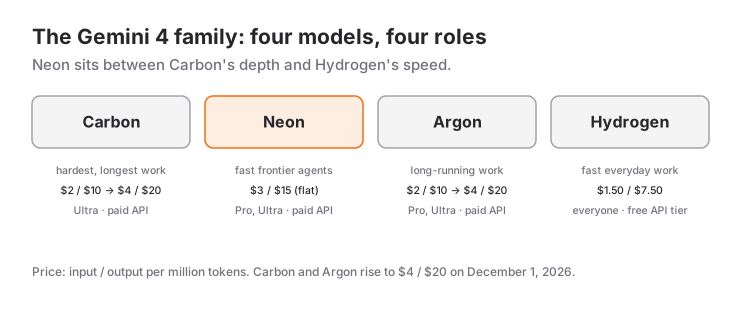
The family timeline now spans seven weeks: Argon was announced September 30 (GA October 13), Carbon on October 28 (GA November 10), Hydrogen launched straight to GA on November 12, and Neon went straight to GA on November 18.
| Model | Role | API price (per 1M tokens, input / output) | Who can use it |
|---|---|---|---|
| Gemini 4 Carbon | Hardest, longest-horizon work | $2 / $10 through Nov 30, $4 / $20 from Dec 1 | Paid API; Google AI Ultra and Enterprise in apps |
| Gemini 4 Neon | Fast frontier coding, knowledge, science | $3.00 / $15.00 | Paid API; Google AI Pro, Ultra and Enterprise in apps |
| Gemini 4 Argon | Long-running work | $2 / $10 through Nov 30, $4 / $20 from Dec 1 | Paid API; Google AI Pro, Ultra and Enterprise in apps |
| Gemini 4 Hydrogen | Fast everyday coding and agents | $1.50 / $7.50 | Free and paid API; Gemini app and Google Search |
Alongside Neon, Google Antigravity gained Orchestrator (Neon). Pro and Ultra subscribers can now have Neon handle read-only planning and review while handing code edits and test runs to the faster, cheaper Hydrogen within a single session. Previously, Pro subscribers only had Orchestrator (Argon). Details are in What Is Antigravity Orchestrator?.
Notice one shift in Google's developer docs: AI Studio's "Choosing a model" guide now centers on Carbon, Neon, Hydrogen, and Gemini 3.5 Flash-Lite, leaving Argon out of its main comparison table even though Argon remains active in the API and Antigravity. All four models are compared in our Gemini 4 family guide.
Benchmark results
Google compares Gemini 4 Neon against Claude Opus 5.5 and GPT-6.2 Sol. The 19-row table below comes from Google DeepMind's model card and the gemini_4_neon_model_evaluation.pdf report (November 2026).
| Benchmark | Gemini 4 Neon | Claude Opus 5.5 | GPT-6.2 Sol |
|---|---|---|---|
| AA Index v5.0.1 | 61 | 59 | 57 |
| Vals Index v2.2 | 70.9% | 70.1% | 66.1% |
| CursorBench 4.1 | 65.4% | 58.1% | not given |
| Terminal-Bench 4.1 (cheating-adjusted) | 65.2% | 65.8% | 61.5% |
| FrontierCode 2.0 (main score) | 46.2% | 47.3% | 43.8% |
| SWE-sweep (provider harness) | 39.0% | 10.1% | 8.3% |
| SWE-sweep (Mini-SWE harness) | 12.8% | 3.6% | 11.6% |
| AutomationBench | 56.3% | 42.5% | 41.3% |
| Agents' Last Exam v1.1 | 75.8% | 71.6% | 73.0% |
| RiemannBench | 84.0% | 80.0% | 80.0% |
| Terminal-Bench-Science 0.1 | 70.5% | 63.3% | 68.0% |
| HLE-Diamond | 71.3% | 67.9% | 64.0% |
| MKA (Climb WSR) | 56.5% | 53.0% | 52.7% |
| Chartography | 73.5% | 66.3% | 75.1% |
| LVBench | 89.0% | 83.7% | 87.6% |
| GraphWalks (256k to 1M, BFS F1) | 95.2% | 66.8% | 80.1% |
| CWE-Bench v2 | 70.7% | 67.1% | 66.0% |
| SEC-bench Pro | 90.5% | not given | 88.3% |
| WebExploitBench v1.2 | 51.3% | 37.1% | not given |
Three caveats matter when reading this table:
- Neon leads 16 of the 19 rows. Claude Opus 5.5 leads on Terminal-Bench 4.1 and FrontierCode 2.0, and GPT-6.2 Sol leads on Chartography. The evaluation PDF also notes that Neon ran FrontierCode 2.0 at
highthinking rather thanxhigh. - The SWE-sweep jump comes from the harness. On the plain mini-SWE harness Neon scores 12.8% (GPT-6.2 Sol 11.6%, Opus 5.5 3.6%). Inside Antigravity-CLI v1.5.9 it triples to 39.0%, and Google's methodology PDF notes why: Antigravity-CLI includes a built-in tool that fans sub-agents out across the codebase, which fits bug-finding tasks especially well. Opus 5.5 ran with Claude Code and Sol with Codex.
- Flagship competitors are left out. Google's table compares against Claude Opus 5.5 and GPT-6.2 Sol, omitting OpenAI's larger
GPT-6.2 Astraand Anthropic'sClaude Fable 5.2. A full methodology audit and flagship comparison are in the comparison post.
In the announcement text, Google also reports 58.6 (#1 overall at launch) on the Artificial Analysis Coding Agent Index, #1 on Vals Legal Research Bench and Vals Tax Agent Bench, $16,843 (#1) on Andon Labs' Vending-Bench 2, and 1336 (#2 globally across 4,200+ real-world agent sessions, plus #2 on steerability) on Arena's Agent Arena Index.
The claims Google highlights
Cost per task. Google says Neon at its default high thinking level delivers a 32% lower cost per task than Carbon on the Artificial Analysis index, roughly 50% to 80% lower cost per task than top competing frontier models on Vals Index and Agent Arena, and 36%+ less per task at xhigh than competing models at their top setting.
Cyber defense (Gemini 4 Neon for cyber). A security variant is rolling out to Fairwind Program defenders over the coming days. Google reports 76% on AutoBaxBench hard tasks (state-of-the-art), 51.26% on WebExploitBench v1.2 at half the cost of competing large models, 90.5% on SEC-bench Pro at roughly half the cost per challenge, frontier ExploitGym performance using half the tokens of Carbon, and 70.7% on Collinear's CWE-bench v2 (+3.4% over Carbon). Keep in mind that cybersecurity benchmarks run with safety mitigations disabled.
Alignment and prompt injection. Google reports 0.0% cheating and 1.98% refusals on Terminal-Bench 4.0 (0% refusals on Terminal-Bench-Science), a 2.45% shortcut rate on its coding cheating evaluation (lowest of any Gemini 4 model), a 0.09% misaligned action rate, and a 99.2% agent honesty pass rate. Compared with Carbon, Google says Neon reduces under-service by 43%–56% and overreach by 15%–35%, and achieved a 0.0% attack success rate on Gray Swan's indirect prompt injection benchmark at xhigh with real-time safeguards active.
Safety comparison in the model card. Automated safety evaluations against Gemini 4 Hydrogen show text-to-text safety unchanged (0.00pp), multilingual safety at -0.40pp, image-to-text safety at +1.90pp, refusal tone at +1.25pp, and unjustified refusals at -3.00pp (meaning Neon turns down benign prompts less often than Hydrogen).
Frontier Safety evaluation. Under Google's Material Capability Change (MCC) assessment against Gemini 4 Argon, Neon showed higher general capability without crossing the MCC threshold, so a full critical-capability re-evaluation was not required; Argon's determinations (including that biological CBRN uplift and cyber uplift CCLs cannot be ruled out) carry forward alongside existing mitigations. A full Safety & Security Report is marked "coming soon."
What the independent measurements show
Live figures from Artificial Analysis's Intelligence Index v5.0.1 page (checked November 19, 2026):
| Model (thinking level) | Index | Cost per index task | Time per task | Output tokens |
|---|---|---|---|---|
Neon xhigh |
61 | $6.44 | 21.5 min | 283M |
Neon high (default) |
60 | $3.74 | 14.8 min | 123M |
Neon medium |
55 | $1.90 | 8.3 min | 62.9M |
Neon low |
44 | $0.75 | 3.7 min | 28.3M |
Gemini 4 Carbon high |
60 | $4.90 | 36.1 min | 200M |
Gemini 4 Hydrogen high |
51 | $1.87 | 8.6 min | - |
Gemini 4 Argon high |
50 | $4.97 | 29.6 min | - |
Four takeaways stand out:
- The "#3 overall" nuance. By model family, Neon at 61 sits behind Claude Fable 5.2 (65) and GPT-6.2 Astra (62). Because Artificial Analysis ranks each thinking-level variant separately, Neon (
xhigh) sits at #6 out of 96 rows on the full leaderboard. - Matches Carbon
highin less than half the time. Athigh, Neon matches Carbon's score of 60 in 14.8 minutes instead of 36.1 minutes and for $3.74 instead of $4.90 per task. Bumping Neon toxhighadds just 1 point (to 61) while raising task cost from $3.74 to $6.44. - Speed and verbosity. Neon outputs 110 tokens per second at
xhigh(101 tok/s athigh), with a 56.51-second time to first answer token atxhigh(40.64s athigh). It consumed 283M output tokens across the index atxhigh(median 65.1M), so Artificial Analysis labels it "notably slow per task and very verbose." - Hallucination rate: 13.9%–14.4%. On AA-Omniscience v1.1, Neon scores 59.4% accuracy with a 13.9% hallucination rate at
high(60.5% accuracy and 14.4% hallucination rate atxhigh). That is higher than Argon (4.3%), Hydrogen (8.5%), and Carbon (11.4%), though far lower than Claude Opus 5.5 (50.3%) and GPT-6.2 Sol (55.4%).
BenchLM added Gemini 4 Neon to its tracker on November 18 with Google's six launch headline scores, noting that zero independent BenchLM rows are published yet.
Price
On the standard API tier, Neon costs $3.00 per million input tokens, $15.00 per million output tokens, and $0.15 per million cached input tokens (95% discount). Batch and Flex cost half ($1.50 / $7.50), Priority is $5.40 / $27.00, and there is no free tier. Pricing is flat across the 1M window with no introductory discount. While Neon's per-token rate sits above Carbon and Argon's temporary $2 / $10 promo price through November 30, Carbon and Argon rise to $4 / $20 on December 1, and Neon already costs less per task than Carbon at high on Artificial Analysis. Full tier details and worked examples are in our pricing and access guide.
Who can use it?
Developers can call gemini-4-neon right now on the paid Gemini API tier in Google AI Studio and Android Studio. Consumers on Google AI Pro and Google AI Ultra can pick it from the Gemini app drop-down. In Google Antigravity (desktop app, CLI, and IDE extensions), Neon is enabled on paid Pro (or eligible device trials), Ultra, and Enterprise plans—and is now the default model for new conversations on plans that include it—while Free and Plus plans are excluded.
No model weights have been released, so Neon cannot be downloaded or self-hosted. The full surface-by-surface matrix is in Is Gemini 4 Neon Free?.
Frequently Asked Questions
What is Gemini 4 Neon?
A Gemini 4 model released by Google DeepMind on November 18, 2026 and adapted from Gemini 4 Carbon. It targets complex coding, multi-step agents, knowledge work, and scientific reasoning with near-Carbon quality at faster completion times.
Is Gemini 4 Neon free?
No. There is no free API tier, and using Neon in the Gemini app or Google Antigravity requires at least a Google AI Pro or Ultra subscription. Hydrogen remains the only Gemini 4 model with free access.
How much does the Gemini 4 Neon API cost?
On the standard paid tier it costs $3.00 per million input tokens, $15.00 per million output tokens (including thinking tokens), and $0.15 per million cached input tokens. Batch and Flex cut prices in half ($1.50 / $7.50), while Priority is $5.40 / $27.00.
What is the difference between Neon and Carbon?
On Artificial Analysis v5.0.1, Neon at high matches Carbon at high with a score of 60 while finishing in 14.8 minutes instead of 36.1 minutes and costing $3.74 instead of $4.90 per task. Neon can also step up to xhigh (score 61). Carbon remains slightly more reliable on AA-Omniscience hallucination rates (11.4% vs. 13.9%) and is positioned for the longest, hardest architecture work.
How do I select Neon in Google Antigravity?
On paid Pro, eligible device trials, Ultra, or Enterprise accounts, Gemini 4 Neon appears at the top of the model selector and is the default for new conversations. Pro and Ultra users can also select Orchestrator (Neon) to plan with Neon and code with Hydrogen.
Can I download Gemini 4 Neon to run locally?
No. Weights have not been published; Neon runs strictly on Google's servers through the Gemini API, Google AI Studio, the Gemini app, and Antigravity.
Sources
- Google, Introducing Gemini 4 Neon (Koray Kavukcuoglu, November 18, 2026): launch overview, benchmark highlights, cost-per-task claims, cyber and alignment metrics.
- Google DeepMind, Gemini 4 Neon model card (November 18, 2026): Carbon lineage, March 2026 cutoff, 19-row evaluation table, safety deltas vs. Hydrogen, Frontier Safety MCC assessment.
- Google DeepMind, Gemini 4 Neon: Model evaluation (November 2026): benchmark methodology, Antigravity-CLI v1.5.9 vs. mini-SWE, competitor sourcing.
- Google AI Studio, Gemini 4 Neon model page: token limits, supported and unsupported capabilities.
- Google AI Studio, What's new in Gemini 4 Neon and Choosing a model: thinking levels, migration checklist, model lineup positioning.
- Google AI Studio, Gemini API pricing and release notes (checked November 19, 2026): Standard, Batch, Flex, and Priority rates, Office document support, and multimodal slicing.
- Google Antigravity, Gemini 4 Neon in Google Antigravity and Choose a model: default model status, 512K context limit, Orchestrator (Neon).
- Artificial Analysis, Gemini 4 Neon, model leaderboard, and Coding Agents (checked November 19, 2026): v5.0.1 scores, speed, TTFT, verbosity, AA-Omniscience v1.1 hallucination rate.
- BenchLM, Gemini 4 Neon (November 18, 2026): launch ledger and independent ranking status.
Related Posts
Gemini 4 Carbon, Neon, Argon, Hydrogen: Which to Choose?
Side-by-side comparison of all four Gemini 4 models: speed, thinking levels, API pricing, plan access and multi-model pairing patterns.
What Is Gemini 4 Hydrogen? Specs, Price, Benchmarks
Google opened Gemini 4 Hydrogen to everyone on Nov 12, 2026: a 1M-token window, $1.50 input pricing and a free API tier. Specs and measurements in one place.
What Is Antigravity Orchestrator? Neon, Carbon, Hydrogen
Orchestrator in Antigravity plans with Neon, Carbon or Argon and writes code with Hydrogen. Orchestrator (Neon) launched Nov 18 for Pro and Ultra.